
Last reviewed: September 2026
Living in Germany/Housing
Finding your neighbourhood in Berlin
Understand Bezirk, Ortsteil and Kiez, then compare areas by commute, services and the everyday routine you actually want.
- The short answer
- 1. Bezirk, Ortsteil and Kiez are not the same
- 2. Start with your real week
- 3. Compare connections, not kilometres
- 4. Visit the immediate area twice
- 5. Decide what “quiet” and “lively” mean to you
- 6. Separate neighbourhood choice from apartment choice
- 7. Be careful with “best neighbourhood” lists
- 8. German you will actually need
- 9. Questions to ask at a viewing
- Frequently asked questions
Finding a neighbourhood in Berlin is not only about choosing a famous district. Your everyday experience depends on the route to work or university, the street around your home, late-evening transport, nearby services and whether the area feels comfortable to you at the times you will actually use it.
This guide helps you understand Bezirk, Ortsteil and Kiez, compare areas without simplistic rankings and talk about what you need in German. It complements the separate guide to finding an apartment, which covers the rental process itself.
The short answer
Do not ask only, “Which Berlin neighbourhood is best?” Ask, “Which daily routine works for me?”
Choose three or four realistic areas and test them against the same criteria:
- travel time for your normal week;
- public transport in the direction you need;
- shops, healthcare and other everyday services;
- noise and street atmosphere at different times;
- green space or nightlife, depending on your priorities;
- the housing options you can realistically consider.
Then visit the street, not only the district centre.
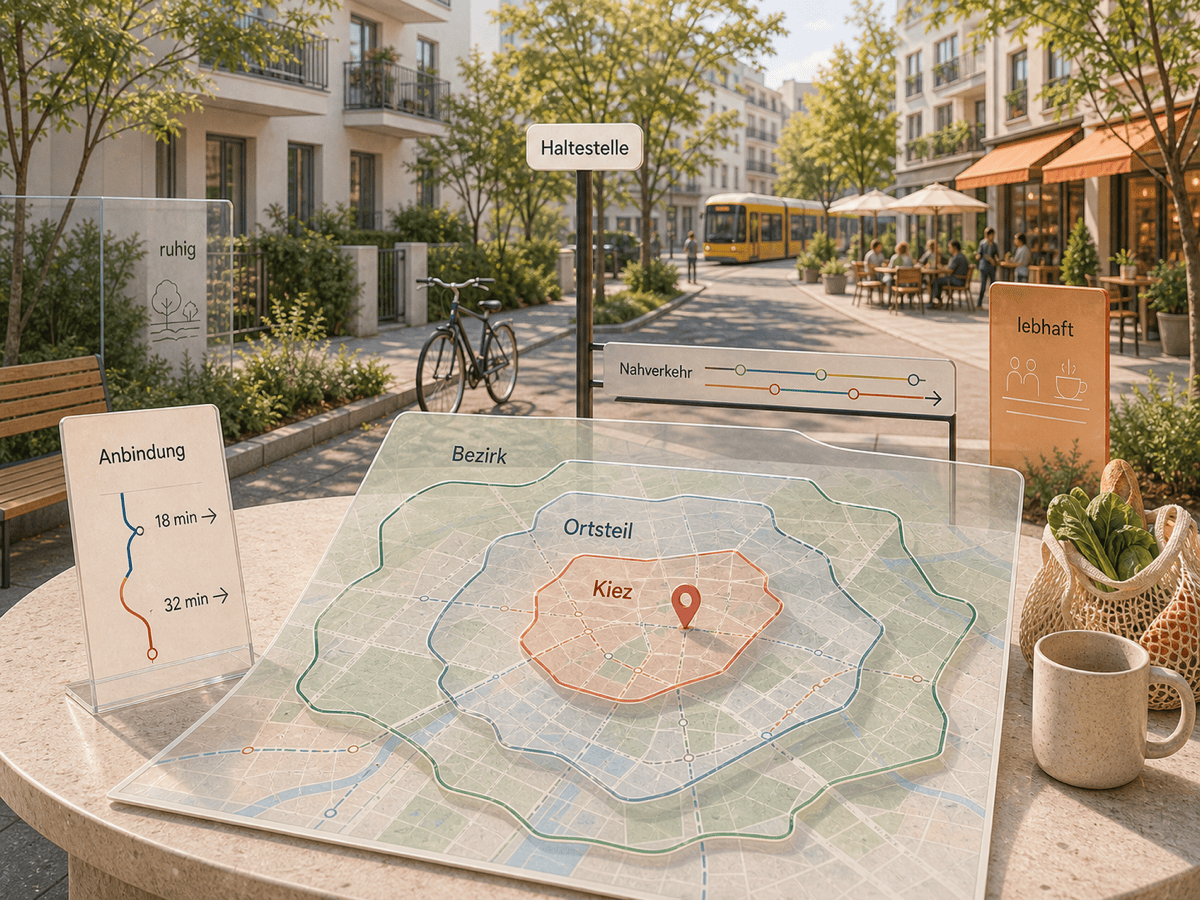
1. Bezirk, Ortsteil and Kiez are not the same
Bezirk
A Bezirk is an administrative borough. Boroughs have local authorities and cover large, varied areas. A borough name alone therefore tells you very little about one particular street.
Ortsteil
An Ortsteil is an officially defined locality within a borough. It is more precise than the borough but can still contain very different residential areas.
Kiez
A Kiez is an informal neighbourhood: the small area people experience as their local everyday world. It may centre on a square, market, street or set of blocks. Kiez boundaries are not official and people may disagree about where one ends.
This is why a housing advert, a resident and a map may describe the same location differently.
2. Start with your real week
Draw a simple map of the places you expect to visit regularly:
- workplace, school or university;
- childcare;
- a doctor or therapy appointment;
- close friends or family;
- a sports club or other regular activity;
- a station for longer journeys.
Do not optimise for a landmark you will visit twice a year. Optimise for repeated trips.
Check the route at the actual times you expect to travel. A connection that looks easy at midday may involve longer waits late in the evening or at weekends. If step-free access matters, use the current accessibility and lift information rather than assuming every transfer works.
3. Compare connections, not kilometres
A shorter geographical distance does not always mean an easier journey. One direct line can be more comfortable than several short changes.
For each possible address, check:
- walking time to the stop;
- number of changes;
- frequency at your travel time;
- an alternative route when one line is disrupted;
- the last part of the journey after dark;
- whether zone C is relevant for work or family outside Berlin.
Useful German words are Anbindung (connection), Nahverkehr (local public transport) and Entfernung (distance).
4. Visit the immediate area twice
Online descriptions often show the most attractive part of a neighbourhood. Your daily life happens near the exact address.
If possible, visit once during the day and once in the early evening. Walk the route from the nearest station. Notice:
- traffic and street noise;
- lighting and how the route feels;
- grocery shops and pharmacies;
- cafés, bars or delivery traffic below the building;
- parks, playgrounds or quiet courtyards;
- bicycle parking and car traffic;
- ongoing construction.
This is not about judging an area by appearance or by who lives there. It is about checking whether the practical environment matches your needs.
5. Decide what “quiet” and “lively” mean to you
People use the same words differently. One person’s lebhaft (lively) is another person’s laut (noisy). One person’s ruhig (quiet) is another person’s “too far from everything”.
Turn broad preferences into observable questions:
- Do you want cafés within five minutes, or a quiet residential street?
- Is a direct night-bus route important?
- Do you need a lift, wide entrance or step-free station?
- Do you want a park nearby, or is a balcony more important?
- How much street noise can you accept with the windows open?
Use these questions at the Wohnungsbesichtigung rather than relying on a neighbourhood label.
6. Separate neighbourhood choice from apartment choice
The perfect Kiez does not make an unsuitable apartment suitable. Check the home and location as two separate decisions.
The apartment
Size, condition, total rent, contract, deposit, energy information and accessibility.
The location
Daily route, street atmosphere, services, noise, green space and local transport.
A balanced choice may be an apartment that meets your core needs in an area you did not originally know.
7. Be careful with “best neighbourhood” lists
Lists often mix tourism, nightlife, housing and personal taste. They can be useful for discovering names, but they are weak evidence for a housing decision.
Use official district pages to understand localities and infrastructure. Use transport planners for current routes. Use a real visit for street-level experience. For rental documents, contracts and fraud risks, follow the housing guide and official consumer information.
8. German you will actually need
9. Questions to ask at a viewing
Wie ist die Anbindung am Abend?How are the transport connections in the evening?
Wie weit ist es bis zur nächsten Haltestelle?How far is it to the next stop?
Ist die Straße nachts eher ruhig oder lebhaft?Is the street rather quiet or lively at night?
Gibt es Einkaufsmöglichkeiten in der Nähe?Are there shops nearby?
Wo kann ich mein Fahrrad abstellen?Where can I park my bicycle?
Frequently asked questions
What is the difference between a Bezirk and a Kiez?
A Bezirk is an official administrative borough. A Kiez is an informal, much smaller neighbourhood shaped by everyday use and local identity.
Does every Kiez have an official boundary?
No. Kiez boundaries are informal and can be interpreted differently. Use the exact address and official locality when accuracy matters.
Which is the best neighbourhood in Berlin?
There is no universal best neighbourhood. The useful choice depends on your routes, budget, housing needs, preferred atmosphere and accessibility requirements.
Should I choose an area before looking for an apartment?
Choose a realistic group of areas rather than one narrow favourite. Berlin’s housing search is easier to manage when you have clear non-negotiables but some geographical flexibility.
How can I check the evening commute?
Use an official journey planner for the day and time you expect to travel, then walk the final route in person if possible. Check current disruption and accessibility information separately.
Is a Kiez the same as an Ortsteil?
No. An Ortsteil is officially defined. A Kiez is informal and usually smaller.
Useful sentences
Dialogue 1 · At an apartment viewing
Show English
Dialogue 2 · Explaining what you need
Show English
Practice
Check what you remember.
Your answers stay in your browser.
1. Which term describes an informal local neighbourhood?
2. Complete the sentence: Die ___ ist auch am Abend gut.
💡 Use the noun for the quality of transport connections.
3. What is the best first question when comparing neighbourhoods?
4. Complete the question: Wie weit ist es bis zur nächsten ___?
💡 Use the word for a public transport stop.
5. Which term is officially defined?
6. Complete the contrast: Die Straße ist nicht laut. Sie ist ___.
Sources checked: 2026-08-14.
Official sources: Berlin.de, “Berlin Districts” · Berlin.de, “Districts and Neighborhoods A–Z” · Berlin.de, “Neighborhoods – A Guide to Berlin’s Kieze” · Berlin.de, “Life in Berlin” · BVG, journey and network information
Free learning pack
Free: your first apartment in Berlin — German survival pack48 words, 18 phrases, 3 dialogues and a move-in checklist — with audio for every German word. Free, in your language.
Get the free pack →