
Last reviewed: September 2026
Living in Germany/Health
Visiting a doctor in Germany
What happens when you need to see a doctor, what to bring, and the German words that make the visit easier.
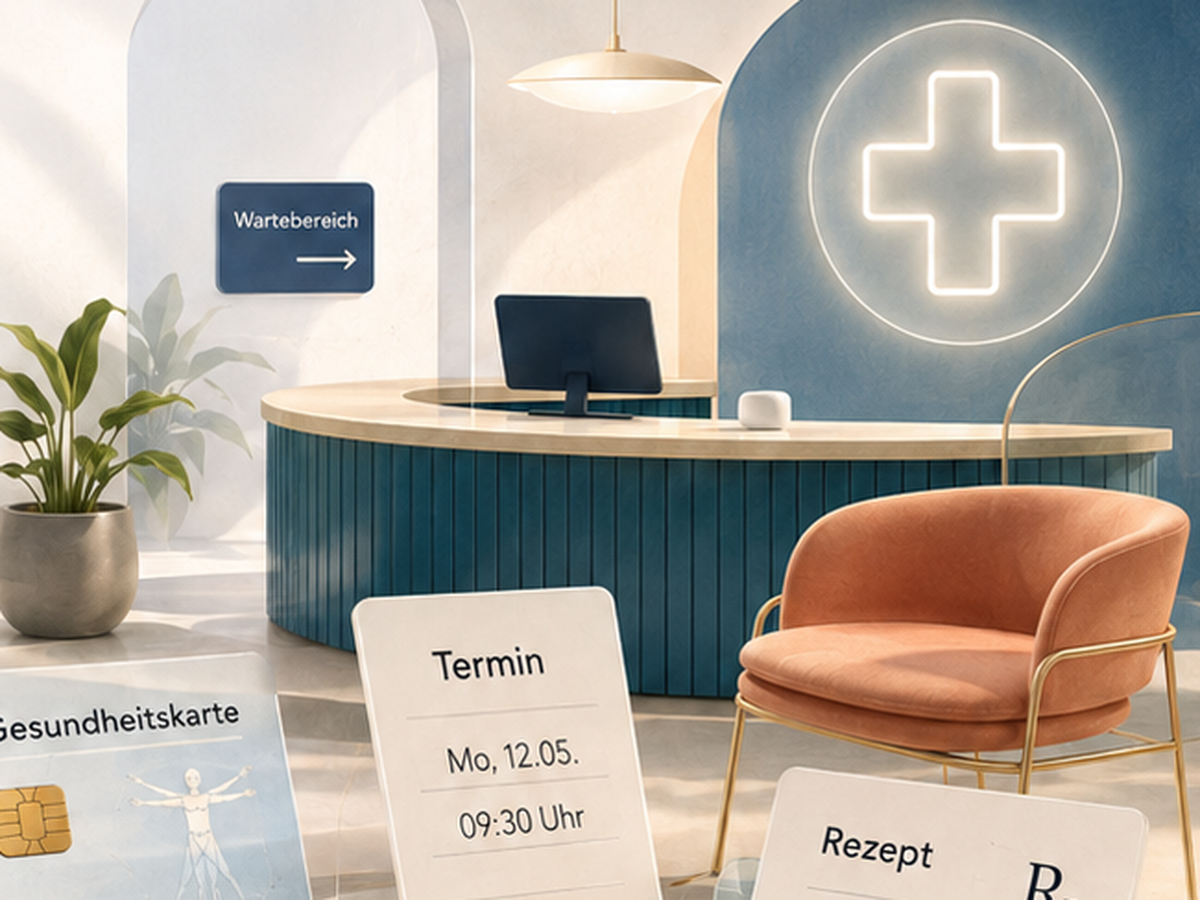
What happens when you need to see a doctor, what to bring, and the German words that make the visit easier.
Quick answer
A doctor visit in Germany usually starts with choosing the right practice and making an appointment. For many general health concerns, people use a Hausarzt, a general practitioner or family doctor. Depending on the situation, you may also contact a Facharzt, a specialist.
If you are covered by German statutory health insurance, your electronic health card, the Gesundheitskarte or eGK, is normally your proof of insurance at the practice. Appointment systems and documents can differ, so it is always worth checking the practice website or calling before you go.
This guide explains the typical process and the German you may need. It does not tell you which treatment is right for you.
1. Finding the right doctor
For a general health concern, a Hausarzt is often a useful first point of contact. A Facharzt focuses on a particular area of medicine. Examples include dermatology, orthopaedics, gynaecology and ophthalmology.
You can search for a medical practice near you through the national 116117 patient service. The service also offers a practice search and appointment services. Individual practices may have their own booking systems.
Before travelling to a practice, check whether you need a Termin, an appointment. Some practices also offer an Akutsprechstunde or other short notice consultation times, but this varies.
Useful question:
Haben Sie heute noch einen Termin frei?
Do you still have an appointment available today?
2. What to bring
What you need depends on your insurance and your situation. A useful basic checklist is:
- your Gesundheitskarte if you are in German statutory health insurance
- any referral, report or previous document that the practice has asked you to bring
- a list of medicines you currently take
- notes about your symptoms and when they started
- questions you want to ask
The electronic health card is used as proof of statutory insurance at doctor and dentist visits. If your insurance situation is different, for example private insurance or international cover, ask the practice or your insurer what proof you should bring.
You do not need to memorise a perfect medical explanation in German. A few clear words about the problem, duration and location are often more useful than a long sentence.
3. At reception
When you enter a practice, look for Anmeldung or Empfang. This is the reception desk.
You may hear:
Ihre Gesundheitskarte, bitte.
Your health card, please.
A simple answer is:
Natürlich. Hier bitte.
Of course. Here you are.
If you have an appointment, you can say:
Guten Tag. Ich habe um 9:30 Uhr einen Termin bei Frau Dr. Weber.
Hello. I have an appointment with Dr Weber at 9:30.
After check in, you may be asked to wait in the Wartezimmer, the waiting room.
4. During the consultation
The doctor may start with:
Was kann ich für Sie tun?
What can I do for you?
Useful building blocks are:
Ich habe Schmerzen hier.
I have pain here.
Ich habe seit drei Tagen Halsschmerzen.
I have had a sore throat for three days.
Es ist seit gestern schlimmer geworden.
It has become worse since yesterday.
Ich nehme diese Medikamente.
I take these medicines.
Ich habe eine Allergie gegen …
I am allergic to …
If you do not understand something, say so. You can ask the doctor to repeat or explain more simply.
Könnten Sie das bitte noch einmal erklären?
Could you please explain that again?
Könnten Sie bitte etwas langsamer sprechen?
Could you please speak a little more slowly?
These sentences are useful because they keep the conversation accurate. You do not need to pretend you understood an important medical instruction.
5. Prescription and pharmacy
A Rezept is a prescription. Prescription medicines are commonly issued electronically as an E-Rezept. The Federal Ministry of Health states that prescription medicines are issued via the electronic prescription system, and insured people can redeem an E-Rezept in several ways, including with the electronic health card, an app or a paper printout.
The place where you collect medicine is the Apotheke, the pharmacy.
Useful questions include:
Wie oft soll ich das einnehmen?
How often should I take this?
Gibt es etwas, worauf ich achten soll?
Is there anything I should pay attention to?
For medical instructions about medicines, always follow the advice of the treating professional or pharmacist rather than a general guide.
6. 116117 or 112
Germany uses different numbers for different levels of urgency.
116117 is the national patient service and medical on call service. It is for urgent medical problems that are not life threatening, especially when regular practices are closed. The service is available around the clock. The 116117 website also provides practice search and appointment functions.
112 is the emergency number for life threatening emergencies.
If you are unsure about the medical urgency of a situation, use the official 116117 and emergency guidance rather than relying on a general website article.
Mini dialogue 1: at reception
Reception: Guten Tag. Wie kann ich Ihnen helfen?
Patient: Guten Tag. Ich habe um 9:30 Uhr einen Termin bei Frau Dr. Weber.
Reception: Ihre Gesundheitskarte, bitte.
Patient: Natürlich. Hier bitte.
Reception: Danke. Nehmen Sie bitte noch kurz im Wartezimmer Platz.
Patient: Danke.
Mini dialogue 2: in the consultation
Doctor: Was kann ich für Sie tun?
Patient: Ich habe seit drei Tagen Halsschmerzen und fühle mich sehr müde.
Doctor: Haben Sie Fieber oder nehmen Sie Medikamente?
Patient: Ich hatte gestern leichtes Fieber. Ich nehme im Moment keine Medikamente.
Doctor: Gut. Dann schauen wir uns das an.
Patient: Könnten Sie bitte etwas langsamer sprechen? Mein Deutsch ist noch nicht so sicher.
Doctor: Natürlich.
Before you go: quick checklist
- Check the practice and appointment information.
- Bring the insurance proof that applies to you.
- Write down medicines and important questions.
- Note when your symptoms started.
- Use simple German sentences when you can.
- Ask for repetition if something important is unclear.
- Use 116117 for urgent, non life threatening care when appropriate.
- Use 112 for life threatening emergencies.
Frequently asked questions
Do I always need an appointment?
Not necessarily, but practice systems vary. Some practices accept short notice or acute consultations, while others work mainly with appointments. Check before you travel if possible.
Do I always need a referral to see a specialist?
No single answer applies to every specialist, insurance arrangement or care pathway. Check the specialist practice and your insurance information before the appointment.
What if I do not speak enough German?
Ask whether the practice can communicate in a language you speak. You can also prepare short German sentences in advance. For important medical information, make sure you have understood the instruction and ask for clarification when needed.
What is the difference between 116117 and 112?
116117 is for the medical on call service and urgent problems that are not life threatening. 112 is the emergency number for life threatening emergencies.
Useful sentences
Dialogue: Reception
Dialogue: Consultation
Practice
Check what you remember.
Your answers stay in your browser.
1. Which German word means appointment?
2. You want to say that you have pain. Which sentence fits?
3. Complete: Hier ist meine ________.
4. Complete: Könnten Sie bitte etwas ________ sprechen?
5. Match the place to the meaning.
6. The practice is closed and you have an urgent problem that is not life threatening. Which official service is designed for this situation?
7. You do not understand an important instruction. What is the best response?
8. What does the receptionist ask for?
9. Put the typical steps in a sensible order.
10. Which phrase asks someone to explain again?
Need a sick note after seeing a doctor?
In Germany, a certificate of incapacity for work (Arbeitsunfähigkeitsbescheinigung, or AU) is usually issued by the doctor treating you in outpatient care. If you are admitted to hospital, your hospital stay can be documented separately. When you are discharged, the hospital can also certify that you are unable to work for up to seven calendar days if necessary. If you only visit a hospital emergency department as an outpatient, do not assume that it will issue a sick note. You may need to see a GP or another outpatient doctor afterwards.
Even with the electronic AU (eAU), you still need to tell your employer promptly that you are unable to work.
Official sources: Federal Ministry of Health: Electronic health card · Federal Ministry of Health: E-Rezept · Patient service 116117