
Last reviewed: September 2026
Living in Germany/Housing
Rental Deposit in Germany: Understanding the Kaution
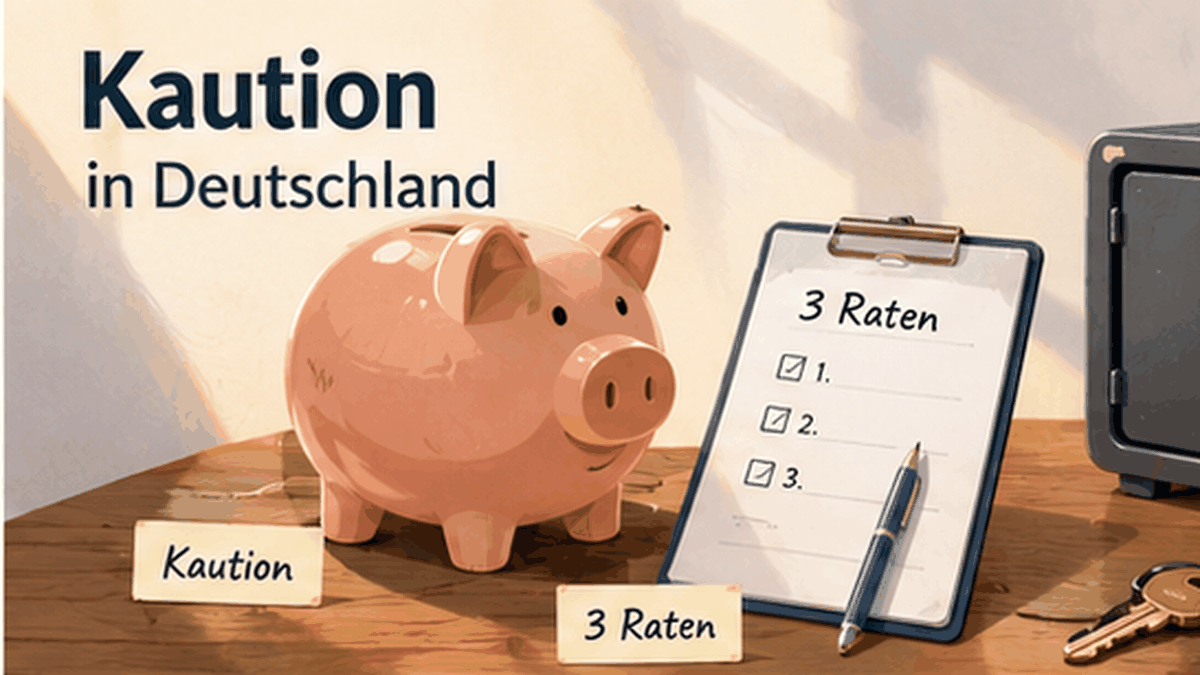
How the Kaution works: the three-month limit, payment in three installments, separate holding of your money and the German words you need.
- Quick answer
- 1. Check the exact deposit amount in the Mietvertrag
- 2. Know that three installments are a tenant right for a cash deposit
- 3. The deposit is security, not an extra fee
- 4. Do not treat the Kaution as the last three months of rent
- 5. Document the condition of the home at move-in
- 6. Keep proof of every deposit payment
- 7. At move-out, separate three questions
- 8. If you are offered a different deposit model, read the conditions first
- Common mistakes to avoid
- Frequently asked questions
The Kaution is one of the biggest upfront costs when you rent a home in Germany. The useful part is that the basic legal framework is unusually clear: there is a limit, a cash deposit can be paid in installments, and the money must be kept separate from the landlord’s own assets.
Quick answer
For a standard residential tenancy, a security deposit may not exceed three times the monthly rent excluding operating costs shown as a flat amount or advance payment. In everyday language, this is usually described as a maximum of three Nettokaltmieten, not three Warmmieten.
If the security is a sum of money, the tenant has the right to pay it in three equal monthly installments. The first installment is due at the start of the tenancy; the next two are due with the following rent payments.
The landlord must keep a cash deposit separate from their own assets. The statutory default is an interest-bearing account at the usual rate for savings with a three-month notice period, although another investment form can be agreed. The interest belongs to the tenant and becomes part of the security.
1. Check the exact deposit amount in the Mietvertrag
Do not calculate the maximum from the Warmmiete.
§ 551 BGB uses the monthly rent without operating costs that are shown as a flat amount or advance payment.
Example:
- Nettokaltmiete: €900
- Nebenkostenvorauszahlung: €220
- Warmmiete shown in the contract: €1,120
The statutory maximum for a standard cash security would be based on the €900 figure: up to €2,700, not €3,360.
This is only an example of the calculation, not a statement that every landlord must ask for the maximum.
2. Know that three installments are a tenant right for a cash deposit
If the required security is a sum of money, you do not have to pay the full amount in one payment simply because the landlord prefers it.
Under § 551(2) BGB:
- the cash deposit can be paid in three equal monthly installments
- the first installment is due at the beginning of the tenancy
- the second and third installments are due with the next two rent payments
A contract term that is worse for the tenant than the protections in § 551 is ineffective to that extent.
3. The deposit is security, not an extra fee
The Kaution exists to secure claims connected with the tenancy. It remains the tenant’s money while serving as security.
That is why the law requires a cash deposit to be held separately from the landlord’s own assets.
Berlin’s official tenant guidance repeats this rule and explains that the landlord must invest the money separately for the tenant; any resulting interest belongs to the tenant and increases the security.
4. Do not treat the Kaution as the last three months of rent
The deposit and the rent are different obligations.
The BGB says the tenant must pay the agreed rent, while § 551 separately regulates the security. That means you should not simply stop paying rent at the end of the tenancy on the assumption that the landlord can “use the Kaution instead.”
If you want a different settlement arrangement, it needs to be clearly agreed. In a dispute, get tenancy advice rather than creating new rent arrears.
5. Document the condition of the home at move-in
The deposit becomes much easier to discuss later if the apartment condition is well documented at the start.
Use the Berlin Apartment Handover guide for the full process. In practical terms:
- make sure existing defects are recorded
- keep the handover protocol
- take clear photos where appropriate
- store the lease and deposit proof together
The Berlin Welcome Center also recommends documenting the apartment condition at move-in so that pre-existing damage can be distinguished later.
6. Keep proof of every deposit payment
Useful records include:
- the signed lease clause showing the Kaution
- bank-transfer confirmation or a receipt
- any written agreement about another security form
- later correspondence about the deposit
Avoid putting unnecessary sensitive data into screenshots that you share with third parties.
7. At move-out, separate three questions
When the tenancy ends, think about the deposit in three layers:
1. Is the apartment returned?
Keys and handover should be documented.
2. Are there claimed damages or unpaid amounts?
If the landlord makes a claim, ask for it to be explained clearly.
3. Is part of the final operating-cost period still open?
Depending on the situation, unresolved claims can affect when the full security is finally settled.
There is no simple “the BGB says the landlord always has exactly X days” rule in § 551. The Berlin Welcome Center advises tenants to seek advice if the deposit has still not been returned after six months. Treat that as a practical point to get help, not as a universal statutory deadline for every case.
8. If you are offered a different deposit model, read the conditions first
Landlord and tenant can agree on another form of security or investment in some situations.
Before accepting a guarantee, blocked account or other model, check:
- who provides the security
- whether there are fees
- whether you get the security back or merely pay for a guarantee service
- how the arrangement ends
- what the lease actually requires
This guide does not recommend a commercial deposit product.
Common mistakes to avoid
- Calculating three months from the Warmmiete instead of the rent excluding operating-cost advances/flat charges.
- Paying the full cash deposit immediately without knowing about the three-installment right.
- Paying without keeping proof.
- Treating the Kaution as a non-refundable landlord fee.
- Skipping the handover record and later arguing about old damage from memory.
- Assuming there is one fixed statutory refund deadline that resolves every deposit case.
Frequently asked questions
Is the Kaution based on Warmmiete?
For a standard residential security under § 551 BGB, the maximum is three times the monthly rent excluding operating costs shown as advance payments or a flat amount. In normal housing language, that usually means three Nettokaltmieten, not three Warmmieten.
Can I pay a cash deposit in three installments?
Yes. § 551 BGB gives the tenant the right to three equal monthly installments. The first is due at the beginning of the tenancy; the next two are due with the following rent payments.
Does the landlord have to keep my deposit separately?
Yes for a cash deposit covered by § 551. It must be held separately from the landlord’s own assets. The statutory default investment and interest rules are also set out in § 551.
Can I use the Kaution instead of paying my final rent?
Do not assume so. The rent obligation and the security deposit are separate. If you want a different settlement, it should be clearly agreed; otherwise continue to follow the rent terms and seek advice if there is a dispute.
Is there an exact six-month legal deadline for every deposit refund?
Do not present six months as a universal statutory deadline from § 551. The timing can depend on unresolved claims. The Berlin Welcome Center advises seeking advice if the deposit is still not back after six months.
Useful sentences
Practice
Check what you remember.
Your answers stay in your browser.
1. A lease shows €850 Nettokaltmiete and €200 monthly Nebenkostenvorauszahlung. What is the statutory maximum cash security under § 551 BGB?
2. When is the first of the three statutory cash-deposit installments due?
3. You are moving out and want to stop paying the last rent because "the landlord already has the Kaution." What is the safest general approach?
Official sources: German Civil Code Section 551 · Berlin Senate: Mietverträge / Kaution · German Civil Code Section 535 · Berlin Welcome Center: Mietvertrag