
Last reviewed: September 2026
Living in Germany/Mobility
Getting around Berlin by public transport
Understand U-Bahn, S-Bahn, fare zones and ticket validation, with the German phrases that make everyday journeys easier.
- The short answer
- 1. Understand the five main transport modes
- 2. Read Berlin’s fare zones
- 3. Choose a ticket by journey pattern
- 4. Validate or activate before the journey
- 5. Read the platform information
- 6. Change lines without stress
- 7. Ticket checks
- 8. Everyday travel etiquette
- 9. German you will actually need
- Frequently asked questions
Berlin’s public transport network combines U-Bahn, S-Bahn, trams, buses and ferries. The same ticket system covers these modes within the zones printed or selected on your ticket. The difficult part for a newcomer is usually not finding a train. It is understanding the direction, fare zone and whether the ticket is already valid.
This guide gives you a practical starting routine and the German words you need for real journeys. Ticket products and conditions can change, so check the current BVG or VBB information before buying.
The short answer
For most journeys inside the city, you first need to know three things:
- your destination and direction;
- the fare zones your journey crosses;
- whether your paper or digital ticket still needs validation or activation.
Berlin uses an open system without entry barriers at most stations. A ticket must still be valid before you travel.
1. Understand the five main transport modes
U-Bahn
The U-Bahn is Berlin’s urban underground and elevated railway. It is useful for frequent inner-city connections.
S-Bahn
The S-Bahn connects the centre, outer districts and surrounding area. It is operated separately from BVG, but the integrated Berlin-Brandenburg ticket system means the same valid local-transport ticket can normally be used across U-Bahn, S-Bahn, tram, bus and ferry within its zones and conditions.
Straßenbahn
The Straßenbahn (tram) is especially common in the eastern parts of Berlin, with additional routes elsewhere.
Bus
Buses fill gaps between rail lines and reach many residential areas. The direction is usually shown by the final stop.
Fähre
Some public ferries are part of the local network. They are not only sightseeing boats; the relevant lines use regular transport tickets under the published conditions.
2. Read Berlin’s fare zones
The network uses three zones:
- A covers the central city area inside and including the S-Bahn ring;
- B extends from the ring to Berlin’s city boundary;
- C covers the surrounding area, including locations such as Potsdam and Berlin Brandenburg Airport.
Tickets are sold for combinations such as AB, BC or ABC. Check the route before buying. A journey to or from BER airport normally requires zone C to be included.
Do not choose a ticket only because its name sounds familiar. Confirm the zones, duration and passenger conditions on the current official product page.
3. Choose a ticket by journey pattern
The official ticket range includes products for one journey, several journeys, a set period, groups, bicycles and subscriptions. The right choice depends on how often you travel and who or what travels with you.
Useful categories to compare are:
- Einzelfahrausweis: a single ticket;
- Kurzstrecke: a short-trip ticket with special stop limits;
- 24-Stunden-Karte: travel under the current 24-hour conditions;
- Monatskarte: a monthly ticket;
- Anschlussfahrausweis: an extension ticket for a journey beyond the zones already covered;
- Fahrradkarte: a separate bicycle ticket where required.
A Berlin single ticket is currently valid for 120 minutes after validation or activation and permits changes and interruptions in one direction; return and circular journeys are excluded. Fares and conditions can change, so check the current BVG information before you travel.
4. Validate or activate before the journey
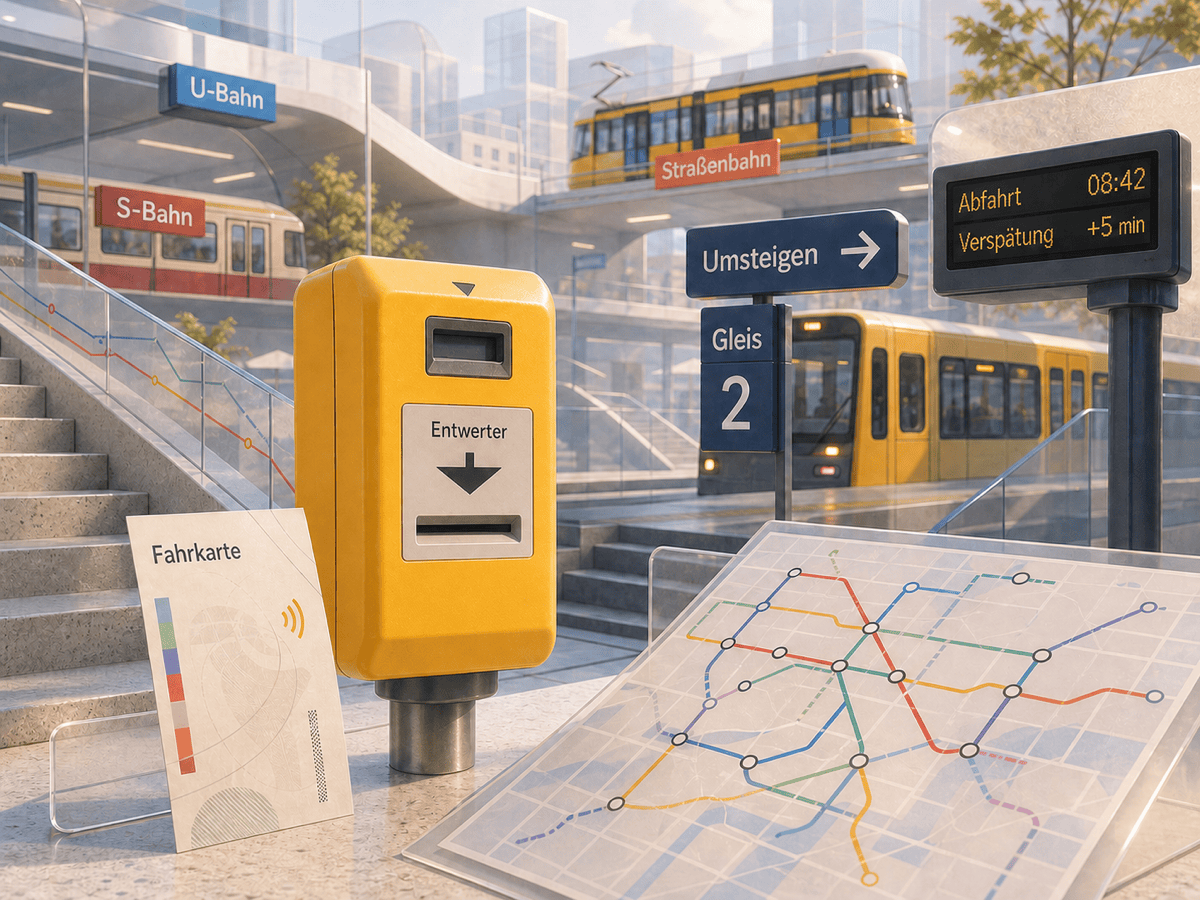
The word entwerten means to validate a paper ticket. Berlin validators are small metal boxes, commonly yellow or red.
For S-Bahn and U-Bahn journeys, a paper ticket that requires validation must be stamped before boarding. On buses, trams and ferries, validation is available according to the vehicle and ticket conditions. Some tickets from machines may already be validated, so read the print on the ticket rather than stamping automatically.
Digital tickets generally need to be activated before the journey unless the product or purchase process states that activation is automatic. Open the ticket screen before entering the vehicle or platform area and check the validity time.
An unvalidated paper ticket that requires validation is not a valid ticket.
5. Read the platform information
The destination shown on a train or display is usually the Endstation, the final stop in that direction. Your own stop may be somewhere before it.
Before boarding, check:
- line number or name;
- direction or final stop;
- platform (Gleis);
- departure time;
- service changes or Verspätung;
- whether you need to umsteigen.
If two routes look similar, ask a direct question:
Fährt diese Bahn zum Alexanderplatz?Does this train go to Alexanderplatz?
Ist das die richtige Richtung?Is this the right direction?
6. Change lines without stress
To umsteigen is to change from one line or mode to another. Route planners often show walking time between platforms, but large stations may still take longer than expected.
When you leave the first train:
- look for the next line symbol and direction;
- follow signs before following the crowd;
- check the new platform display;
- allow extra time if you need a lift or step-free route;
- do not buy a new ticket merely because you changed vehicles if your current ticket remains valid for the journey.
7. Ticket checks
A Fahrkartenkontrolle can take place on vehicles or in the transport area. Show the valid ticket and any required supporting document. A personalised ticket may require identification.
If you receive a document during a check, keep it. The official BVG ticket-control page explains the current procedure, deadlines and payment options. Do not pay through an unofficial link sent later by message.
8. Everyday travel etiquette
Simple habits make busy journeys easier:
- let passengers leave before boarding;
- keep door areas clear;
- move further into the vehicle when it is crowded;
- prepare to leave before your stop;
- use headphones at a considerate volume;
- offer priority spaces to people who need them;
- check lift status and step-free routing when accessibility matters.
These are practical courtesies, not a substitute for the operator’s conditions of carriage.
9. German you will actually need
Frequently asked questions
Can I use one ticket for U-Bahn, S-Bahn, tram and bus?
Yes, a valid integrated local-transport ticket can be used across these modes within the fare zones, time period and passenger conditions of that ticket.
Do I always need to validate a paper ticket?
No. Some paper tickets are already validated when sold, while others must be stamped before travel. Read the ticket and the current official instructions. Never stamp a ticket twice unless the product specifically requires separate sections to be validated.
Does a digital ticket need activation?
Many digital tickets must be activated before the journey, while some are valid immediately after purchase or from a selected time. Check the ticket status in the app before boarding.
Which zone includes BER airport?
BER airport is in fare zone C. A journey between central Berlin and the airport therefore normally needs an ABC ticket or another product that covers the full route.
Can I change trains with a single ticket?
Under the current BVG conditions, changes and interruptions are allowed during the validity period of a Berlin single ticket, but the journey must continue in one direction. Return and circular trips are excluded.
What does “Zug fällt aus” mean?
It means the train is cancelled. Check the display or route planner for an alternative connection.
Useful sentences
Dialogue 1 · Before boarding
Show English
Dialogue 2 · Changing lines
Show English
Practice
Check what you remember.
Your answers stay in your browser.
1. Which zone includes Berlin Brandenburg Airport?
💡 The airport is outside the Berlin city boundary.
2. Complete the question: Wo muss ich ___?
💡 Use the verb for changing to another line.
3. What is an Entwerter?
4. Complete the sentence: Die Bahn hat zehn Minuten ___.
💡 This noun describes a delay.
5. Which sentence checks whether you are travelling the right way?
6. Complete the question: Von welchem ___ fährt der Zug?
Sources checked: 2026-08-14.
Official sources: BVG, “Transportation & tariff zones” · BVG, “Tourist tickets” · BVG, “All tickets at a glance” · BVG, “FAQ for tourists” · BVG, “Ticket control”