
Last reviewed: September 2026
German Perfect Tense: How the Perfekt Works
The Perfekt is one of the most important German past tenses. You will hear it constantly in everyday conversation when people talk about what happened or what they did:
Ich habe gestern lange gearbeitet.
Wir sind am Wochenende nach Leipzig gefahren.
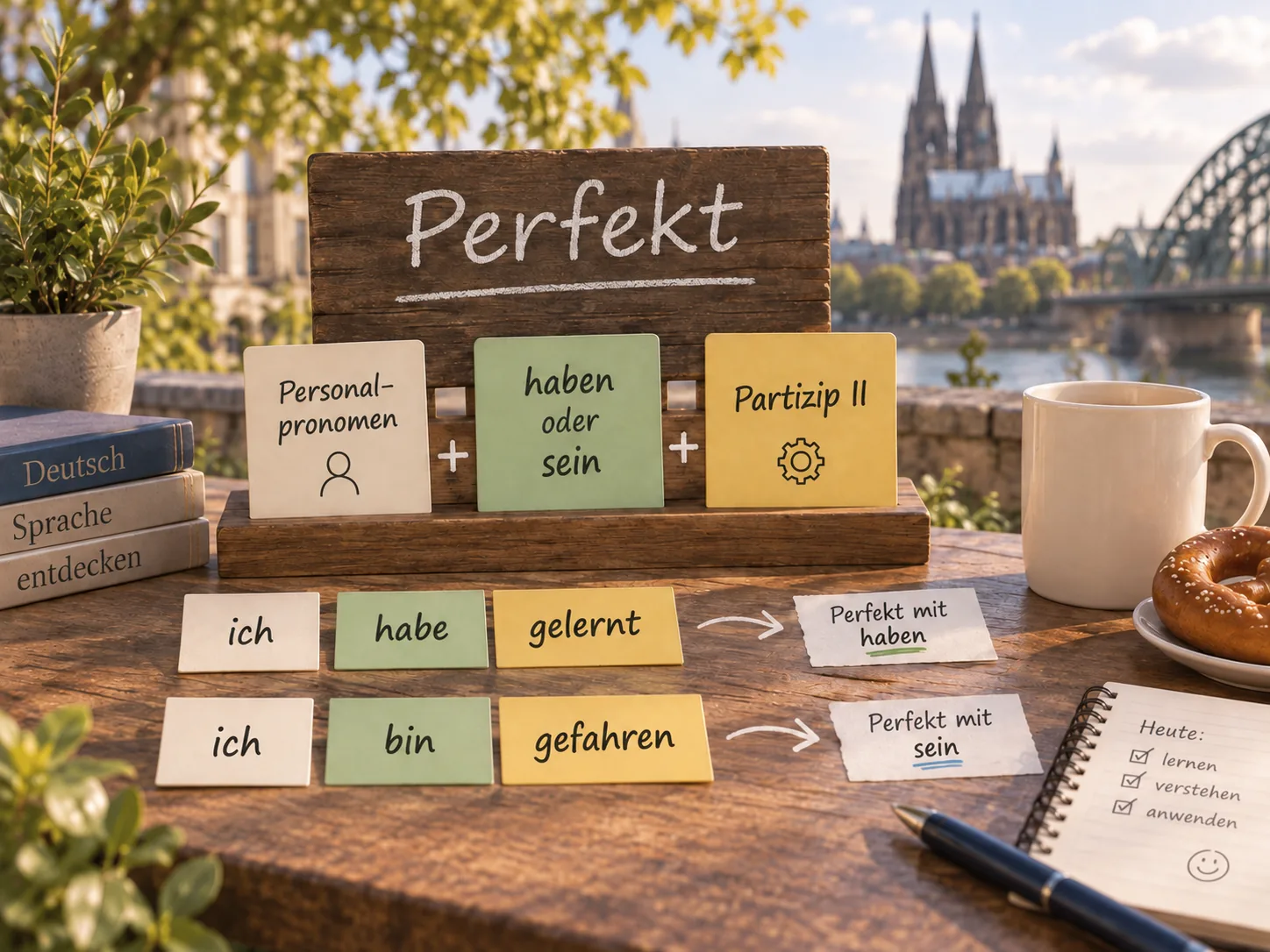
The basic structure is straightforward: use a conjugated auxiliary verb – haben or sein – plus the Partizip II (past participle) of the main verb.
What is the German Perfekt?
Perfekt talks about past events. In spoken German it often covers situations that English would express with either the simple past or the present perfect.
That is why translating the tense name as ‘present perfect’ can be misleading. Compare:
Gestern habe ich einen Film gesehen.
Yesterday I watched a film.
German naturally uses Perfekt here even though English uses the simple past.
How to form the Perfekt
The basic pattern is:
subject + haben/sein + … + Partizip II
For example:
Ich habe einen Kaffee getrunken.
Maria ist früh aufgestanden.
Wir haben den Zug nicht gesehen.
In a main clause, the conjugated auxiliary normally sits in position two, while the participle goes to the end.
Haben or sein?
Most verbs use haben
Ich habe gearbeitet.
Wir haben gegessen.
Sie hat Deutsch gelernt.
Even some verbs of movement use haben when they take a direct object:
Ich habe das Auto in die Garage gefahren.
I drove the car into the garage.
Sein is common with a change of place or state
Many intransitive motion verbs use sein when the subject changes location:
Ich bin nach Hause gegangen.
Wir sind nach Hamburg gefahren.
A change of state often works the same way:
Das Kind ist eingeschlafen.
Er ist aufgewacht.
A few common verbs also belong here, including bleiben and passieren:
Wir sind zu Hause geblieben.
Was ist passiert?
When in doubt, learn the auxiliary together with the verb.
How to form the Partizip II
Regular verbs
Many regular verbs follow ge- + stem + -t:
- machen → gemacht
- lernen → gelernt
- kaufen → gekauft
Strong and irregular verbs
Many strong verbs end in -en and may change their stem vowel:
- trinken → getrunken
- schreiben → geschrieben
- sehen → gesehen
You will need to learn many of these forms individually.
Separable verbs
With separable verbs, ge normally appears between the prefix and the verb stem:
- aufstehen → aufgestanden
- einkaufen → eingekauft
- anrufen → angerufen
Inseparable prefixes
Verbs beginning with prefixes such as be-, emp-, ent-, er-, ge-, miss-, ver-, zer- normally do not add ge-:
- besuchen → besucht
- verstehen → verstanden
- erzählen → erzählt
Verbs ending in -ieren
Verbs ending in -ieren also form the participle without ge-:
- studieren → studiert
- telefonieren → telefoniert
Perfekt or Präteritum?
Both can describe the past. Perfekt is especially common in everyday spoken German:
Ich habe ihn gestern gesehen.
Präteritum is more common in written narration:
Er ging zur Tür und öffnete sie.
But you will also hear Präteritum regularly with sein, haben and modal verbs:
Ich war müde.
Ich hatte keine Zeit.
Ich musste arbeiten.
This does not mean forms such as ich bin gewesen or ich habe gehabt are impossible. What sounds natural depends on the verb, region, style and context.
Word order in questions and subordinate clauses
In a yes/no question, the auxiliary moves to the front:
Hast du den Film gesehen?
With a question word:
Wann bist du nach Berlin gekommen?
In a subordinate clause, the conjugated auxiliary moves to the end:
Ich weiß, dass er gestern lange gearbeitet hat.
Mini exercise
Put these sentences into the Perfekt:
1. Ich lerne Deutsch. 2. Wir fahren nach Köln. 3. Sie kauft Brot ein. 4. Er versteht die Frage. 5. Ihr bleibt zu Hause.
Answers:
1. Ich habe Deutsch gelernt. 2. Wir sind nach Köln gefahren. 3. Sie hat Brot eingekauft. 4. Er hat die Frage verstanden. 5. Ihr seid zu Hause geblieben.
The Perfekt in 30 seconds
- Perfekt = haben/sein + Partizip II.
- Most verbs use haben.
- Many verbs involving a change of location or state use sein.
- The participle normally goes to the end of a main clause.
- German Perfekt is not simply the same thing as English present perfect.
- Perfekt is very common in conversation; Präteritum remains important, especially with sein, haben and modal verbs.
Once the German sentence bracket starts to feel familiar, Perfekt becomes much easier. You can see the same kind of structural thinking in our guide to Wo or Wohin? German Accusative vs Dative.
More from Language & Culture
The German Language: All You Need to Know →Why Do Germans Love Döner Kebab So Much? →Free placement test →