
Last reviewed: September 2026
Exploring German Dialects: An Introductory Guide
German does not sound the same everywhere. Travel from Hamburg to Cologne, Frankfurt, Stuttgart or Munich and you will hear noticeable differences in pronunciation, vocabulary and sometimes grammar.
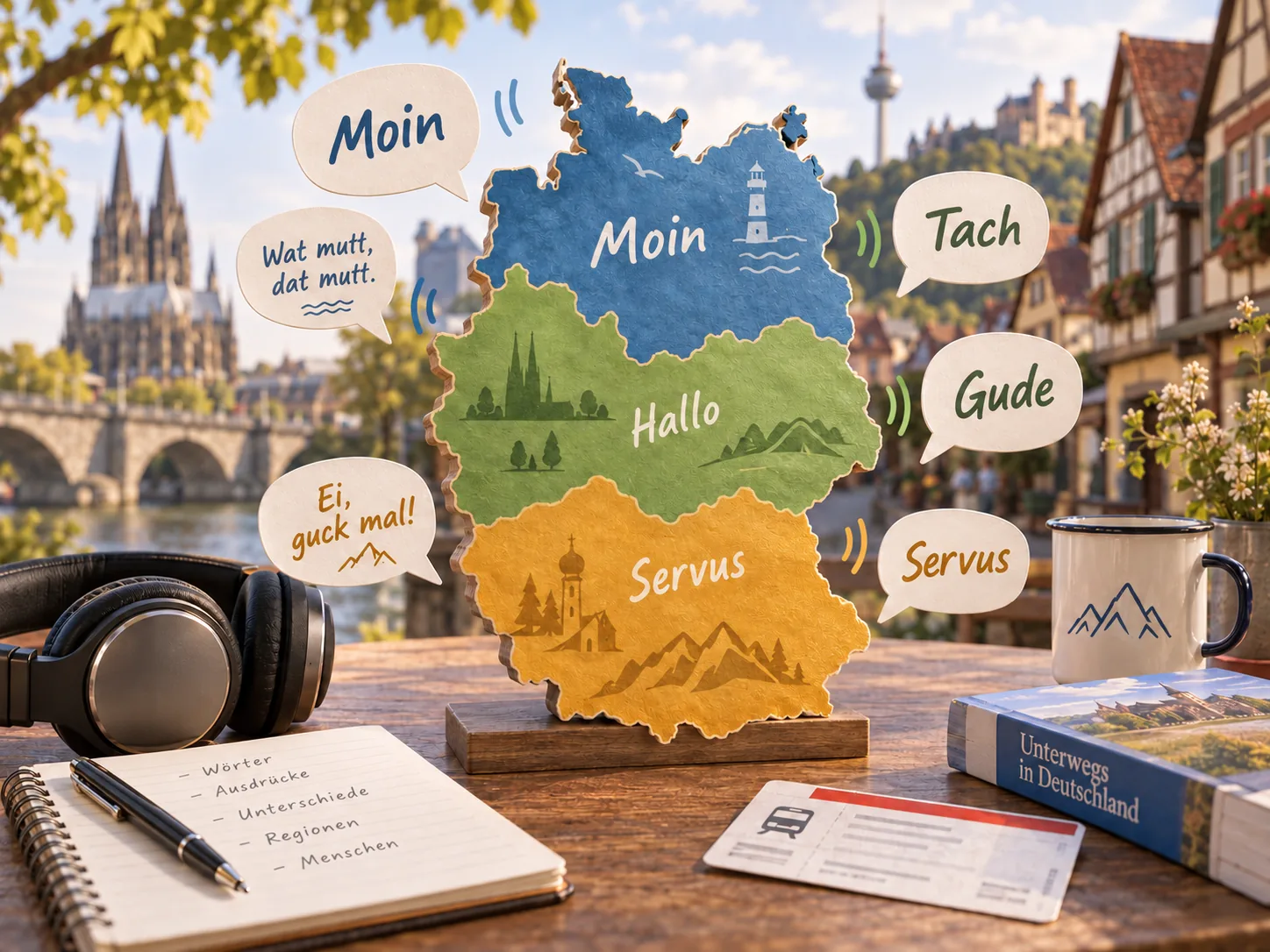
For German learners, that raises a few obvious questions. What does Hochdeutsch actually mean? Is Bavarian spoken everywhere in Bavaria? Where does Swabian fit in? And how many German dialects are there?
There is no single universally accepted number. German dialects form a network of regional varieties with many transition zones, so the answer depends on how finely linguists draw the boundaries.
High German and Low German: the broad division
Traditional German dialectology distinguishes two large areas: Low German (Niederdeutsch) in the north and High German (Hochdeutsch) farther south. High German is then divided into Central German (Mitteldeutsch) and Upper German (Oberdeutsch).
This classification is closely connected to the historical High German consonant shift. The shift affected southern varieties more strongly than northern ones. A classic contrast is Low German maken versus Standard German machen.
There is one potential source of confusion: in everyday German, Hochdeutsch is also often used to mean Standard German. In dialectology, however, High German refers to a historical and geographical group of dialects.
Low German (Niederdeutsch or Plattdeutsch)
Traditional Low German dialects are associated with northern Germany, roughly north of the Benrath line. They can sound very different from the Standard German that learners meet in textbooks.
Today, many speakers in northern Germany use regional forms of Standard German more often than a strong traditional dialect. Low German varieties nevertheless remain an important part of Germany’s linguistic landscape and are extensively documented in modern dialect research.
Central German dialects
Central German covers a broad belt between the Low German and Upper German areas. It includes groups such as Hessian, Thuringian, Upper Saxon, Moselle Franconian, Rhine Franconian and Ripuarian.
Hessian
“Hessian” is not one single way of speaking. It covers several regional varieties, so speech in Frankfurt, Kassel and the Odenwald can differ considerably.
Thuringian and Upper Saxon
Central and eastern Germany also contain many local varieties. What people casually call “Saxon” is linguistically a much more varied landscape with several regional forms and transition areas.
Rhineland dialects and Kölsch
The Rhineland is particularly rich in regional speech. Kölsch, associated with Cologne, belongs to the Ripuarian group. Düsseldorf, Bonn, Aachen and the surrounding regions have their own varieties too.
Upper German dialects
Upper German includes major groups such as Bavarian, Alemannic and several Franconian varieties.
Bavarian
Bavarian dialects are spoken in large parts of Bavaria and Austria, with major regional variation inside the group itself.
The German terms can be confusing: Bairisch usually refers to the dialect group, while bayerisch can simply mean “Bavarian” in the sense of the federal state. Not everybody in Bavaria speaks a Bavarian dialect; Franconia and Bavarian Swabia belong to different dialect areas.
Swabian and Alemannic
Swabian belongs to the Alemannic dialect area. One well-known feature is the diminutive ending -le, as in Häusle.
Most Swiss German dialects are Alemannic too. Swiss German is therefore not simply Bavarian spoken with a Swiss accent; it belongs mainly to another dialect group.
Franconian dialects
Franconian is another umbrella term rather than a single dialect. Different Franconian varieties are classified in different Central and Upper German groups. That is why speech in Lower Franconia, Upper Franconia and the Rhine-Main region can sound very different.
What is the hardest German dialect to understand?
There is no objective winner. Difficulty depends on what you already know, where you learned German and how strongly somebody is speaking their local dialect.
A learner who has only heard Standard German may initially struggle with strong Alemannic, Bavarian or Low German. Someone from the same region may understand the same speech effortlessly.
The practical takeaway is reassuring: you do not need to master every dialect to communicate in Germany. Standard German gives you a strong common foundation, and your ear for regional speech will grow with exposure.
How to get better at understanding German dialects
- Listen to interviews, local radio or podcasts from different regions.
- Watch German-language films and series and notice how characters speak.
- Compare a few sounds or expressions at a time instead of trying to “learn a dialect” all at once.
- Ask German speakers about local words when you hear something unfamiliar.
- Keep your own speaking focused on clear Standard German unless you genuinely want to adopt regional features.
Dialects are not incorrect German. They are part of the history and identity of the language — and they make listening to German across the country much more interesting.
Sources
- Leibniz Institute for the German Language: https://pub.ids-mannheim.de/laufend/sprachreport/pdf/sr11-2a.pdf
- Research Centre Deutscher Sprachatlas / REDE: https://www.regionalsprache.de/
More from Language & Culture
Unusual Facts about Berlin →Akkusativ and Dativ: Wo? and Wohin? →Free placement test →