
Last reviewed: September 2026
German Compound Words: How to Understand Long German Nouns
Haustürschlüssel, Sprachkursanmeldung, Lieblingskaffeetasse: German words can become long because several words can be combined into one new word. These combinations are called Komposita, or compound words.
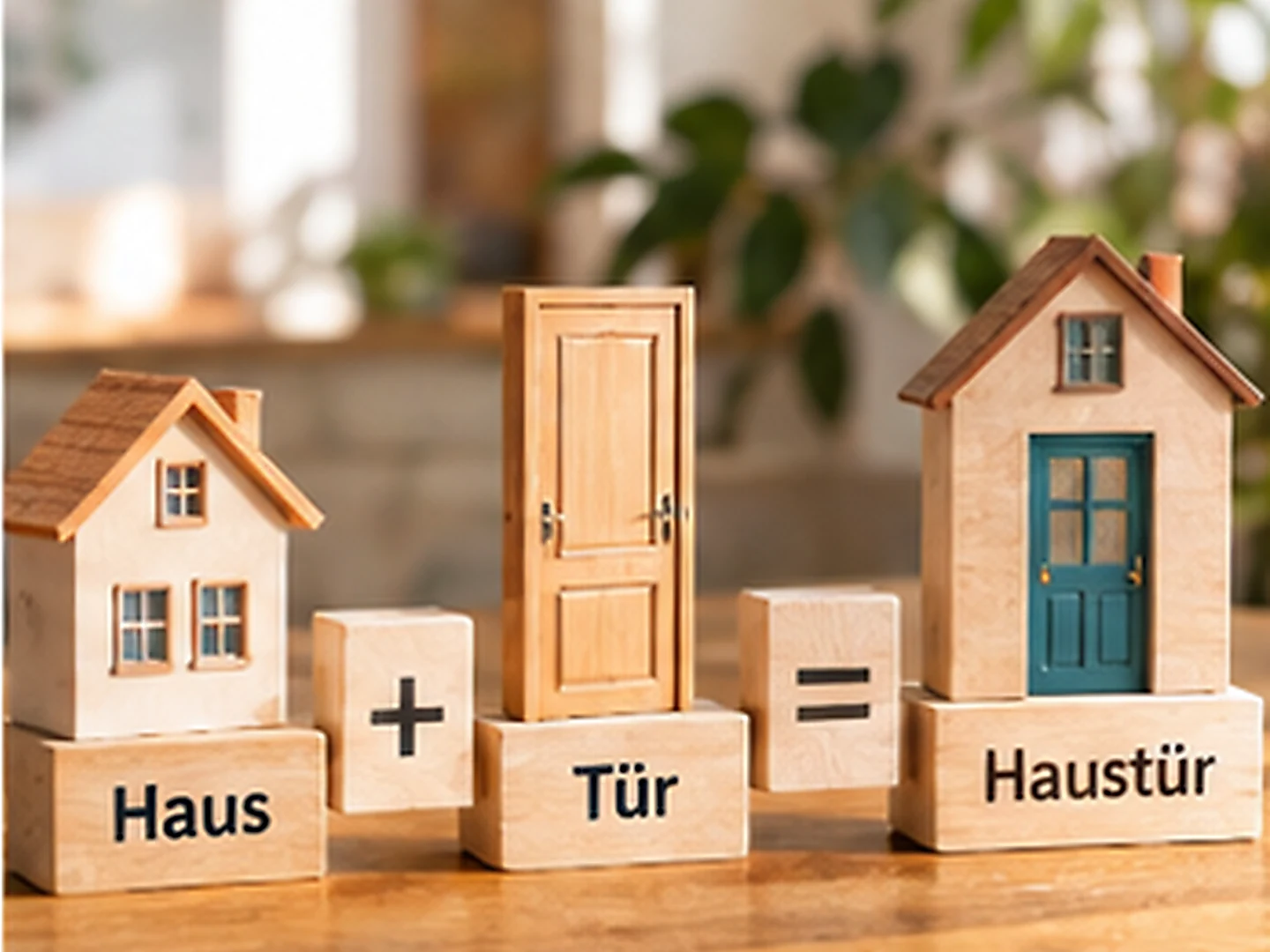
The good news is that long German nouns become much easier when you stop reading them as one enormous block from left to right. Start with the final word. It usually tells you what kind of thing the compound is – and, for compound nouns, it normally determines the grammatical gender too.
What is a German compound word?
A compound is created when at least two words form one new unit.
For example:
Haus + Tür = Haustür
Sprache + Kurs = Sprachkurs
Kaffee + Tasse = Kaffeetasse
In many German noun compounds, it is useful to distinguish two roles:
- Bestimmungswort – the part that specifies or modifies the meaning
- Grundwort – the final element and the grammatical core of the compound
In Kaffeetasse, Kaffee- specifies the meaning and -tasse is the head. A Kaffeetasse is first of all a Tasse, a cup – more specifically, a coffee cup.
The final noun determines the gender
This is one of the most useful rules for German learners: in a compound noun, the final noun normally determines the article.
die Tür → die Haustür
der Schlüssel → der Haustürschlüssel
das Zimmer → das Kinderzimmer
die Anmeldung → die Sprachkursanmeldung
You do not need to calculate a new gender from every part of a long word. Find the final noun.
The head word also normally determines how the compound behaves grammatically and how it is inflected.
How to break down a long German word
Take this example:
Sprachkursanmeldung
Step 1: Find the last word.
Anmeldung
Now you know the word refers to a registration.
Step 2: Registration for what?
for a course
Step 3: What kind of course?
a language course
So:
Sprach + Kurs + Anmeldung = Sprachkursanmeldung
Another example:
Haustürschlüssel
- Schlüssel = the core: a key
- Türschlüssel = a key for a door
- Haustürschlüssel = a key for the front door
With very long compounds, working from right to left is often the easiest strategy.
Why is there sometimes an extra letter between the parts?
Not every compound joins two words directly. German sometimes uses a linking element called a Fugenelement.
For example:
Arbeit + Zeit → Arbeitszeit
Schönheit + Ideal → Schönheitsideal
Kind + Garten → Kindergarten
Linking elements can include forms such as -s-, -es-, -n-, -en- or -er-.
The important point for learners is that there is no single simple rule that predicts every linking element correctly. Some patterns are common, but many forms simply belong to the established word.
That is why it helps to learn the full compound:
die Arbeitszeit – not die Arbeitzeit
der Freundschaftsdienst – not der Freundschaftdienst
Are German compounds always written as one word?
German compounds are very often written as one word:
Sprachschule
Deutschkurs
Sommerurlaub
Bahnhofseingang
This is one reason written German can contain words that look enormous at first sight.
Hyphens can be used or required in particular types of compounds, especially where the components make the word difficult to read. For everyday learning, however, the key idea is simpler: when several nouns form one new concept, German often writes them together without spaces.
Compound words are not just absurdly long nouns
Discussions about German compounds often jump immediately to spectacular administrative words. They can be entertaining, but they are not the most useful way to understand how compounding works.
Most compounds are short and completely normal:
- Haustür
- Zahnbürste
- Fahrkarte
- Wörterbuch
- Lieblingsfilm
- Sprachkurs
- Mittagspause
You will use words like these constantly once you start speaking German.
Compounds can actually make vocabulary easier
Compound words are not only a difficulty. They can help you understand unfamiliar vocabulary.
If you recognise the parts, you can often guess the meaning:
Fahrradwerkstatt
Fahrrad + Werkstatt → a workshop for bicycles
Winterjacke
Winter + Jacke → a jacket for winter
Wohnungsschlüssel
Wohnung + Schlüssel → a key for an apartment
You do not always need to learn a long word entirely from zero. Several of its building blocks may already be familiar.
Three steps for an unfamiliar compound
When you meet a long word while reading:
1. Find the head word at the end
What kind of thing is this basically?
2. Separate the parts you recognise
Which smaller words can you identify?
3. Express the relationship as a short phrase
Is it an X for Y, an X made of Y, an X with Y, or an X that belongs to Y?
This turns a long word into a small meaning puzzle rather than a language monster.
Mini exercise
Break down these words:
1. Bücherregal 2. Sommerferienplan 3. Deutschunterricht 4. Bahnhofshalle 5. Sprachlernapp
Possible answers:
- Bücher + Regal → a shelf for books
- Sommer + Ferien + Plan → a plan for the summer holidays
- Deutsch + Unterricht → German lessons
- Bahnhof + Halle → the hall of a railway station
- Sprache + Lernen + App → an app for language learning
Long German words become easier when you see the building blocks
The most useful skill with German compounds is not memorising the longest word you can find. It is building one simple habit:
When you see a long compound noun, look to the right first.
The head word tells you what the whole word is and normally gives you its gender. Then you can work through the other parts step by step.
Once you start doing that automatically, many intimidating German words become surprisingly logical.
More from Language & Culture
Berlin's Museum Island: Five Museums, History and Art in the Heart of Berlin →Berghain and Berlin Club Culture: More Than a Famous Door →Free placement test →