
Last reviewed: September 2026
Living in Germany/Study & Education
Studying in Germany: application, admission and first steps
Understand how studying in Germany works and learn the German terms you need for university life.
- Quick answer
- 1. Find the right Studiengang
- 2. Check whether your previous education qualifies
- 3. Check the language requirement
- 4. Apply through the correct route
- 5. Zulassung and Immatrikulation
- 6. Your first weeks at university
- 7. German that helps in class
- Mini dialogue 1: at student administration
- Mini dialogue 2: in a seminar
- Before you apply: quick checklist
- Frequently asked questions
Understand how studying in Germany works and learn the German terms you need for university life.
Quick answer
Studying in Germany usually starts with finding a suitable Studiengang, checking the entrance and language requirements, applying through the process used by that university and then completing Immatrikulation, formal enrolment, after you receive admission.
There is no single application route for every university. Some institutions use their own portals, some use uni-assist for certain applications, and admission rules depend on the programme and the applicant’s previous education.
Once you are enrolled, everyday university life brings a new set of German words. Vorlesung, Seminar, Übung, Tutorium, Prüfungsamt and Sprechstunde are worth learning early.
This guide focuses on the study process and university language. Visa and residence requirements are separate topics and depend on the individual case.
1. Find the right Studiengang
Studiengang means degree programme.
Germany has universities and other recognised higher education institutions offering different forms of study and degrees. The Higher Education Compass provides programme information supplied and updated by the higher education institutions themselves.
Before you apply, check:
- the subject and degree
- the teaching language
- the admission requirements
- whether admission is restricted
- application deadlines
- the application route
Useful words:
Bachelor bachelor’s degree
Master master’s degree
Zulassung admission
Zulassungsbeschränkung admission restriction
Bewerbungsfrist application deadline
2. Check whether your previous education qualifies
To enter a German higher education programme, you need a recognised higher education entrance qualification or another accepted route for that programme.
For qualifications obtained outside Germany, recognition depends on the educational background and the programme. The Higher Education Compass explains that foreign school qualifications can provide access if they are recognised as suitable for higher education in Germany. In some cases, a preparatory Studienkolleg may be part of the route.
Do not rely on a general article for a final admission decision. The university and the relevant official admission tools are the source of truth for your case.
3. Check the language requirement
Not every programme is taught in German. Germany also has international programmes with substantial teaching in another language.
For German taught programmes, universities can require recognised proof of German language ability. The exact accepted certificate and required result depend on the institution and programme.
Useful question:
Welche Deutschkenntnisse brauche ich für diesen Studiengang?
What German level do I need for this degree programme?
If the programme is in English, German can still be extremely useful for everyday university life, administration, housing and part time work.
4. Apply through the correct route
Bewerbung means application.
The correct application route depends on the university and programme. Some applications go directly to the university. Some participating universities use uni-assist to evaluate international applications.
If uni-assist is responsible for your application, its process includes checking information, planning the application, preparing documents, applying online, paying the processing fee and tracking the application.
Do not assume that every German university uses uni-assist. Always follow the instructions for the specific programme.
Useful sentence:
Wo muss ich mich für diesen Studiengang bewerben?
Where do I need to apply for this degree programme?
5. Zulassung and Immatrikulation
Zulassung means admission.
Zulassungsbescheid is an admission letter or notice.
Immatrikulation means enrolment. It is the formal step that makes you a registered student at the institution after the relevant admission conditions are met.
The university tells you which documents, payment and deadlines apply to enrolment.
After enrolment, you may receive access to university systems and a Studierendenausweis, a student ID. Many universities also have a Semesterbeitrag, a semester contribution. The amount and what it covers are specific to the institution.
Useful sentence:
Welche Unterlagen brauche ich für die Immatrikulation?
Which documents do I need for enrolment?
6. Your first weeks at university
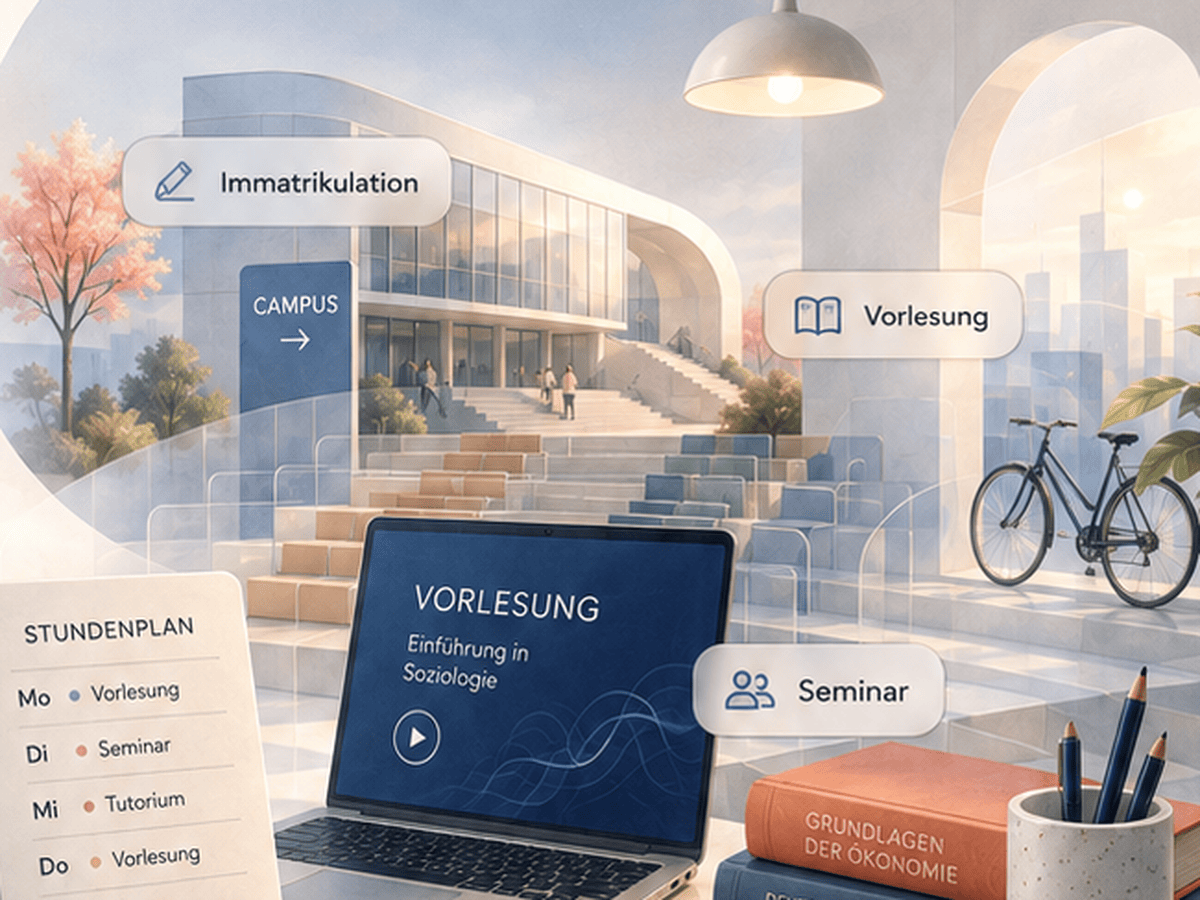
A university timetable is the Stundenplan.
Common teaching formats include:
Vorlesung lecture
Seminar seminar
Übung exercise class
Tutorium tutorial
A lecturer may have a Sprechstunde, an office hour for questions.
Administrative places and services can include:
Studierendensekretariat student administration office
Prüfungsamt examinations office
Bibliothek library
Mensa student canteen
International Office international office
Learn the name of the office responsible for your question before you go. This often saves time.
7. German that helps in class
Useful sentences include:
Entschuldigung, ich habe eine Frage.
Excuse me, I have a question.
Könnten Sie das bitte wiederholen?
Could you please repeat that?
Was bedeutet dieser Begriff?
What does this term mean?
Bis wann müssen wir die Aufgabe abgeben?
By when do we have to submit the assignment?
Wo finde ich die Unterlagen zur Vorlesung?
Where can I find the materials for the lecture?
These short sentences can make a big difference when you are still building academic German.
Mini dialogue 1: at student administration
Student: Guten Tag. Ich möchte mich immatrikulieren.
Staff: Haben Sie Ihren Zulassungsbescheid dabei?
Student: Ja. Welche Unterlagen brauchen Sie noch?
Staff: Bitte prüfen Sie die Liste in Ihrem Bewerbungsportal. Dort sehen Sie die Unterlagen für Ihren Studiengang.
Student: Danke. Wann bekomme ich meinen Studierendenausweis?
Staff: Die Informationen dazu bekommen Sie nach der Immatrikulation.
Mini dialogue 2: in a seminar
Student: Entschuldigung, ich habe eine Frage.
Lecturer: Ja, bitte.
Student: Könnten Sie den letzten Begriff bitte noch einmal erklären?
Lecturer: Natürlich. Welchen Begriff meinen Sie?
Student: Den Begriff auf der zweiten Folie.
Lecturer: Gut. Schauen wir ihn uns noch einmal an.
Before you apply: quick checklist
- Choose a programme and institution.
- Check the official entry requirements.
- Check the teaching language and accepted language proof.
- Check the application route for that specific programme.
- Check the application deadline early.
- Prepare the required documents and translations if applicable.
- After admission, follow the university’s enrolment instructions.
- Learn the key German office and classroom words before the semester starts.
Frequently asked questions
Do all degree programmes require German?
No. Germany has programmes with substantial teaching in other languages, including international programmes. The teaching language and language proof are programme specific.
Does every international applicant apply through uni-assist?
No. uni-assist handles applications for participating universities and specific procedures. Other applications go directly to the university or through another admission route. Follow the instructions for the programme you choose.
What is Immatrikulation?
Immatrikulation is formal enrolment at the university. The institution tells you which documents, payments and deadlines apply.
Is this guide also a visa guide?
No. Visa and residence requirements are separate and depend on nationality and individual circumstances. Use the relevant official authority information for those questions.
Useful sentences
Dialogue: Student Admin
Dialogue: Seminar
Practice
Check what you remember.
Your answers stay in your browser.
1. What does Immatrikulation mean?
2. Which word means lecture?
3. Complete: Wann ist die ________?
4. Complete: Wo finde ich meinen ________?
5. Match the university terms.
6. You want to know where to submit an application. Which sentence fits?
7. Does every international applicant apply through uni-assist?
8. What does the student ask the lecturer to do?
9. Put the study steps in a sensible order.
10. Which office deals with examinations?
Official sources: Higher Education Compass: Studying in Germany · Higher Education Compass: Foreign entrance qualifications · Higher Education Compass: Application and admission · uni-assist: How to apply