
Last reviewed: September 2026
Why Do Germans Love Döner Kebab So Much?
Döner is part of everyday life in Germany. It is quick, filling, easy to customise and available in almost every large city. You can order it mild or spicy, with or without onions, in bread or as a dürüm, with meat or as a vegetarian version.
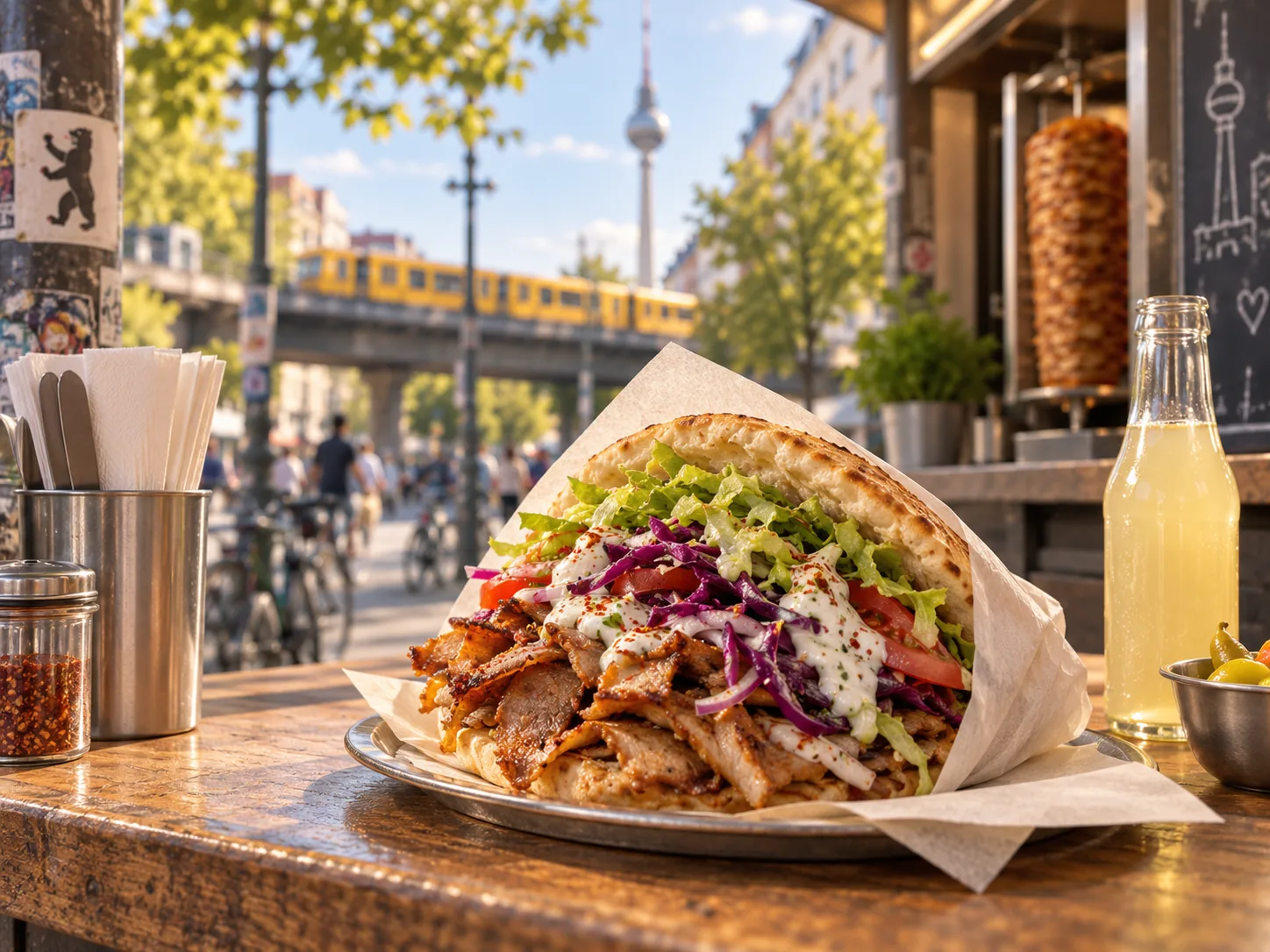
Its popularity is not just about convenience, though. The story of döner in Germany is also a story about migration, urban life and the way food changes when traditions meet in a new place.
Is döner Turkish or German?
The best answer is: both, depending on what you mean.
Döner kebab, meat cooked on a vertical rotating spit and sliced as it roasts, has roots in Ottoman and Turkish cuisine. The sandwich-style version that became especially popular in Germany – meat in bread with salad and sauce – is closely associated with Turkish migration and with West Berlin in the 1970s.
Kadir Nurman is often credited with selling meat from a döner spit in bread near Bahnhof Zoo in 1972. Other restaurateurs have also been named as early pioneers. Rather than treating one person as the undisputed inventor, it is more accurate to see the German döner sandwich as a Berlin success story shaped by several people and businesses.
1. Döner fits city life
You do not need a reservation or a long lunch break. A döner is fast to order, easy to take away and substantial enough to count as a full meal. That combination works particularly well in busy cities.
This practicality was part of its appeal from the beginning: hot food that could fit into the rhythm of a working day or a late night out.
2. Everyone can customise it
There is no single fixed döner combination. Shops offer different meats, breads, vegetables and sauces, as well as dürüm wraps, boxes and vegetarian or vegan alternatives using falafel, halloumi or grilled vegetables.
That flexibility is one of the reasons the format travels so well. Two people can order at the same counter and end up with very different meals.
3. The textures do a lot of the work
A classic döner brings together hot roasted meat, soft or crisp bread, fresh vegetables and creamy sauce. Herbs, acidity and chilli can add another layer. The contrast between warm and cool, soft and crunchy is a big part of the appeal.
There is no universal recipe, either. In Berlin alone, bread, meat, salad and sauces vary considerably from one shop to the next.
4. Döner is tied to everyday memories
For many people in Germany, döner is linked to ordinary moments: a lunch break, the walk home after a night out, a quick meal with friends, or food after a long day at work.
That creates nostalgia. Not because döner is an ancient German dish, but because it has been part of everyday life for several generations.
5. It tells a German-Turkish story
The rise of döner in Germany is inseparable from Turkish migration. After the 1961 recruitment agreement between West Germany and Turkey, many people moved from Turkey to Germany for work. They built families, businesses, restaurants and food shops, permanently shaping the country’s culture.
Döner is therefore more than a convenient snack. It shows how a culinary tradition can adapt in a new environment and become something shared. German döner culture is rooted in Turkish food traditions and is also part of modern German everyday culture.
Why Berlin is so closely associated with döner
Berlin has a large Turkish-German community and a long street-food tradition, so the city appears in almost every account of döner’s rise in Germany. Even if the exact identity of the first person to put this version into bread is debated, the connection between Berlin and döner is not.
For more of the city’s everyday culture, continue with our unusual facts about Berlin.
Sources
More from Language & Culture
How to Order Food in German →5 Historical Facts About Berlin →Free placement test →