
Last reviewed: September 2026
Living in Germany / Daily Life
Cycling in Berlin: the words and rules you need
Understand the signs, street words and short German phrases that make everyday cycling in Berlin easier.
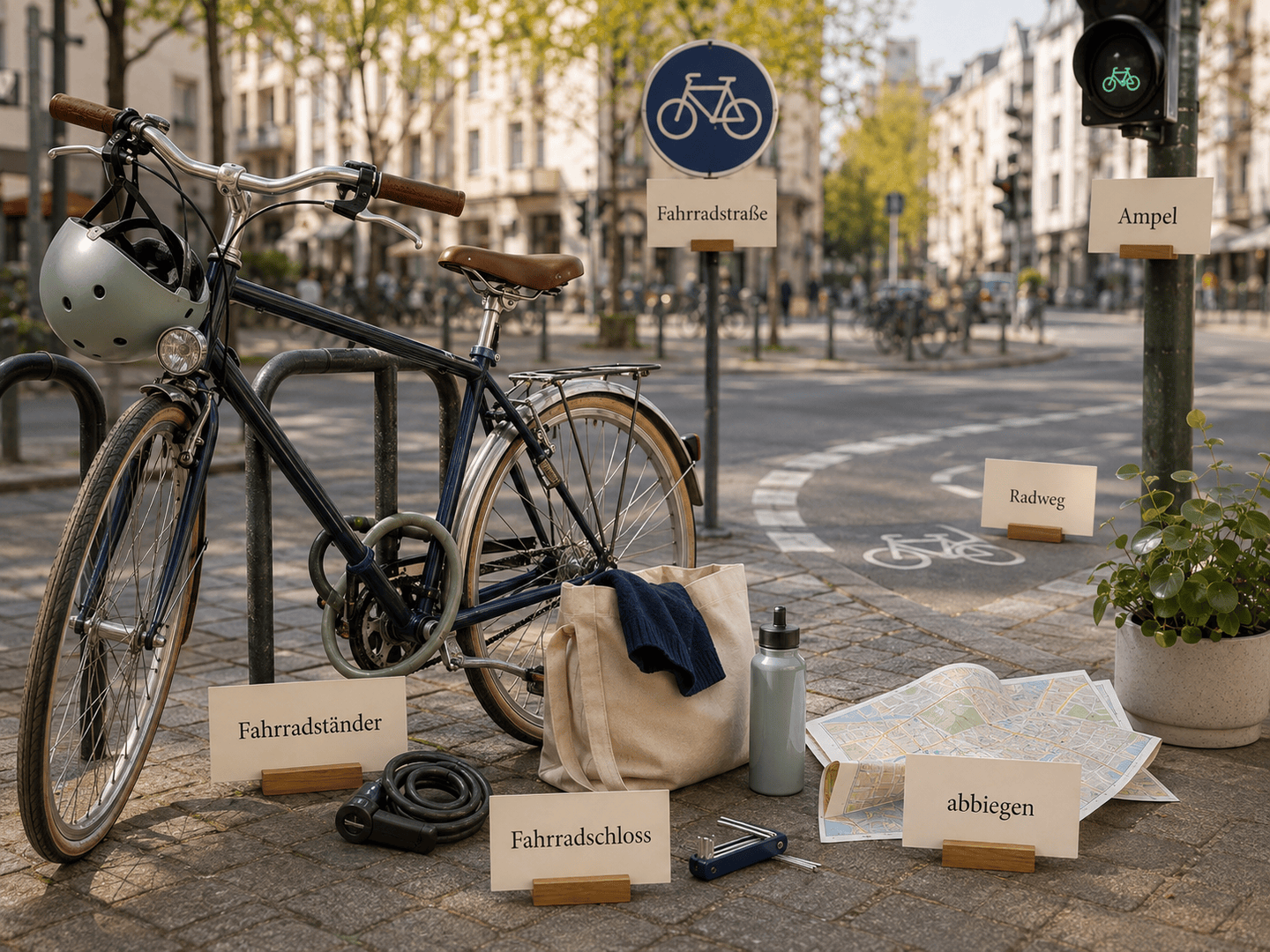
A bicycle can be one of the easiest ways to move around Berlin. But the street vocabulary is not always obvious when German is new to you. Is that a Radweg? What is a Fahrradstraße? Which signal applies at the next junction? And how do you ask someone where you can safely leave your bike?
This guide gives you the most useful German for everyday cycling and a practical orientation to common Berlin street situations. Traffic rules are safety-critical and can depend on signs, markings and the exact location. Always follow the current signs and official rules where you are riding.
1. Radweg, Radfahrstreifen and Schutzstreifen
The general word Radweg means cycle path or bike path. In Berlin you will see several different types of cycling infrastructure.
You may also see:
- Radfahrstreifen: a marked cycling lane separated from the rest of the carriageway by a solid line
- Schutzstreifen: a cycling advisory lane marked differently on the road
- physically separated cycle paths beside the road
Polizei Berlin explains that not every physically separated cycle path is automatically compulsory; signs and road markings determine what applies. The practical lesson for a learner is simple: look at both the road and the signs, not only the colour of the pavement.
Useful sentence:
Wo verläuft hier der Radweg?
Where does the cycle path run here?
2. Fahrradstraße: a street designed around cycling
A Fahrradstraße is a street where cycling has a special priority in how the street is used.
Berlin’s official guidance explains that bicycle streets are generally reserved for cycle traffic. Motor vehicles may use them when an additional sign allows this, for example for local access. Cyclists may ride side by side, and the maximum speed is 30 km/h for all vehicles using the bicycle street.
You do not have to remember every legal detail from an article. What matters in the street is the actual sign in front of you.
Useful phrase:
Ist das eine Fahrradstraße?
Is this a bicycle street?
3. Ampel: which signal applies?
Ampel means traffic light. Berlin junctions can have separate signals for pedestrians, cycles and general traffic.
If there is a signal specifically for the cycling route you are using, follow that signal and the relevant road markings. If the junction is unfamiliar, slow down and make sure you understand the route through it.
Useful words:
grün: green
rot: red
warten: wait
weiterfahren: continue riding
A useful sentence is:
Welche Ampel gilt für den Radweg?
Which traffic light applies to the cycle path?
4. Abbiegen: turning left or right
abbiegen means to turn.
rechts abbiegen: turn right
links abbiegen: turn left
At a busy junction, your route can depend on the markings and cycling infrastructure. Berlin Police describes both direct and indirect ways of turning left in appropriate situations. For everyday use, do not improvise across lanes when you are unsure. Follow the marked route or stop somewhere safe and check.
Language you may need:
Ich möchte links abbiegen.
I want to turn left.
Wo kann ich hier sicher abbiegen?
Where can I turn safely here?
5. Fahrradständer and Fahrradschloss
A Fahrradständer is a bicycle stand or rack. A Fahrradschloss is a bicycle lock.
Berlin has many different types of bicycle parking. The useful language is straightforward:
Wo ist der nächste Fahrradständer?
Where is the nearest bicycle stand?
Ich schließe mein Fahrrad hier an.
I am locking my bicycle here.
Avoid blocking entrances, walking routes or other traffic space. Look for a normal parking location and local signs.
6. Directions you will actually hear
Cycling conversations often use short direction words:
geradeaus: straight ahead
rechts: right
links: left
an der Kreuzung: at the junction
hinter der Ampel: after the traffic light
vor der Brücke: before the bridge
Example:
Fahren Sie geradeaus und biegen Sie an der zweiten Ampel rechts ab.
Go straight ahead and turn right at the second traffic light.
7. A useful safety habit: read the street, not just the map
A navigation app can show a route, but the street in front of you is the source of truth. Construction, temporary diversions and local signs can change what you need to do.
When you are unsure:
- slow down
- look for cycling signs and markings
- avoid sudden movements
- stop somewhere safe if you need to check your route
German words are useful, but safe observation comes first.
Mini dialogue: finding the cycle route
Cyclist: Entschuldigung, wo verläuft hier der Radweg?
Local: Geradeaus bis zur Ampel. Danach beginnt eine Fahrradstraße.
Cyclist: Muss ich an der Ampel rechts abbiegen?
Local: Nein, erst geradeaus. Hinter der Ampel dann links.
Cyclist: Danke. Gibt es dort auch einen Fahrradständer?
Local: Ja, direkt vor dem Platz.
Cyclist: Perfekt, danke!
German you actually need
Useful phrases
Practice
Practice
Suggested level: A2–B1
Exercise 1: Match the word
- Radweg
- Fahrradstraße
- Ampel
- abbiegen
- Fahrradständer
- Fahrradschloss
a. bicycle lock
b. traffic light
c. turn
d. bicycle street
e. cycle path
f. bicycle stand
Exercise 2: Choose the best phrase
- You want to ask where the bike path runs.
A. Wo verläuft hier der Radweg?
B. Wo ist die Hausordnung?
C. Haben Sie einen Kita-Platz?
- You want to turn left.
A. Ich möchte links abbiegen.
B. Das ist Restmüll.
C. Ich habe einen Kita-Gutschein.
Exercise 3: Fill in the blanks
Use: Radweg · Fahrradstraße · Ampel · abbiegen · Fahrradständer
- Ist das eine __________?
- Wo verläuft der __________?
- Welche __________ gilt hier?
- Ich möchte rechts __________.
- Wo ist der nächste __________?
Exercise 4: Put the directions in order
A. Hinter der Ampel links abbiegen.
B. Geradeaus fahren.
C. Am Fahrradständer anhalten.
D. Bis zur Ampel fahren.
Exercise 5: Your turn
Describe a short cycling route in German using geradeaus, Ampel and abbiegen.
Show answers
Exercise 1: 1-e, 2-d, 3-b, 4-c, 5-f, 6-a.
Exercise 2: 1-A, 2-A.
Exercise 3: 1 Fahrradstraße, 2 Radweg, 3 Ampel, 4 abbiegen, 5 Fahrradständer.
Exercise 4: B, D, A, C.
Exercise 5: Open answer.
Frequently asked questions
What does Radweg mean?
Radweg is the general German word for a cycle path or bike path.
What is a Fahrradstraße in Berlin?
It is a street designed with special priority for cycle traffic. Berlin’s official guidance says motor vehicles generally need an additional permission sign to use it, cyclists may ride side by side and the maximum speed is 30 km/h.
Do I have to use every bike path I see?
Not necessarily. Berlin Police explains that the obligation depends on the type of cycling facility and applicable traffic signs. Follow the signs and markings at the location.
What does abbiegen mean?
It means to turn. links abbiegen is turn left; rechts abbiegen is turn right.
What is a Fahrradständer?
It is a bicycle stand or rack where bikes can be parked and locked.
Is this guide a replacement for German traffic rules?
No. It is language and practical orientation. Current traffic signs, official rules and the situation on the street always take priority.
Sources & note
Sources checked
- Berlin.de: Fahrradstraßen: Vorrang für den Radverkehr
https://www.berlin.de/sen/uvk/mobilitaet-und-verkehr/verkehrsplanung/radverkehr/weitere-radinfrastruktur/fahrradstrasse/
- Polizei Berlin: Wann müssen Radwege benutzt werden?
https://www.berlin.de/polizei/aufgaben/verkehrssicherheit/risikogruppen/artikel.108049.php
Related guides
Getting around Berlin by public transportMobilityVisiting a doctor in GermanyHealthAnmeldung in GermanyFirst Days & Paperwork