
Last reviewed: September 2026
Living in Germany / Daily Life
Recycling and waste in Berlin: what goes where
Learn the six Berlin waste words that make bins, glass containers and recycling centres much easier to understand.
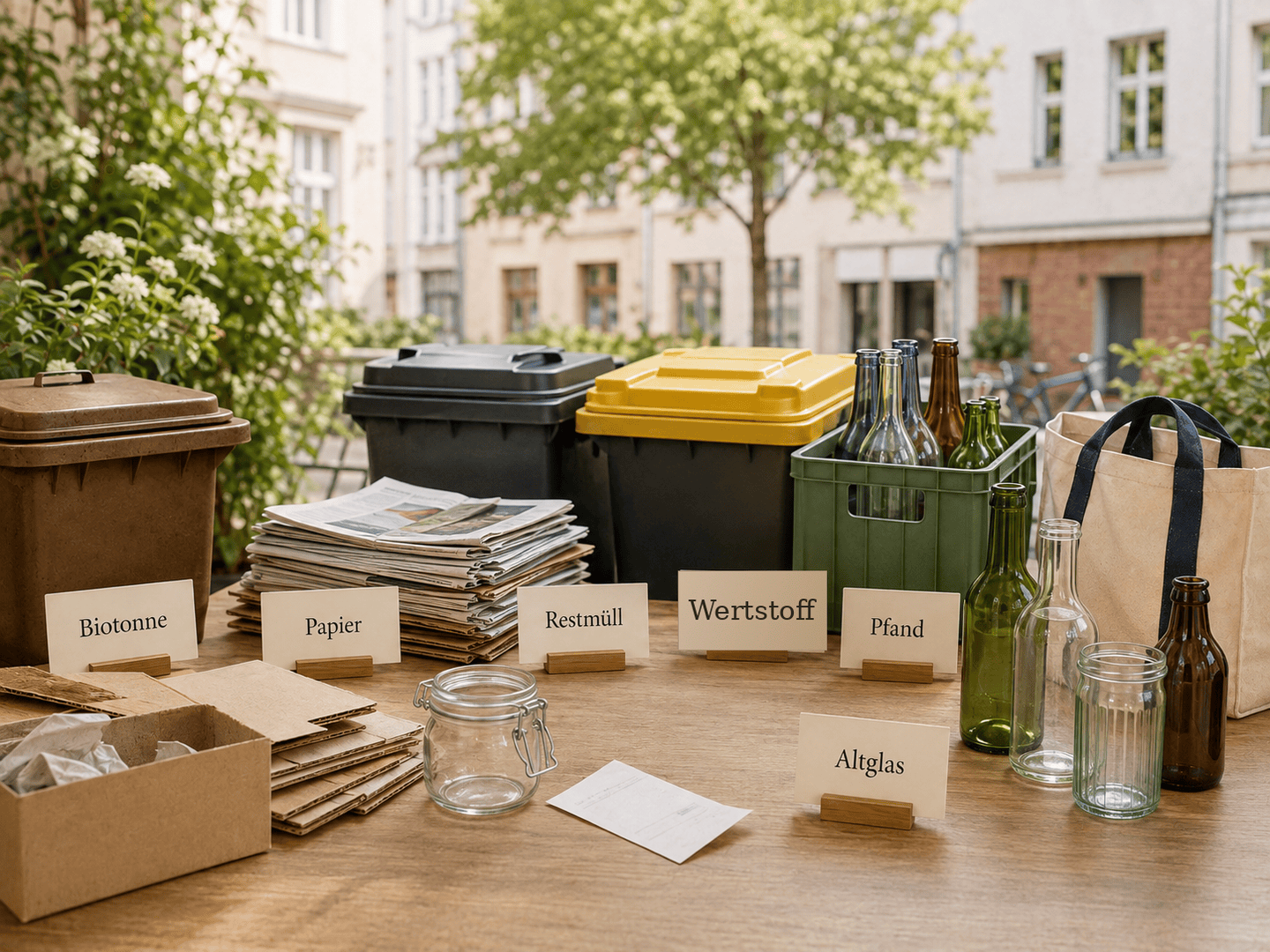
Berlin has several different waste streams, and the colours and names can be confusing when you have just moved in. The useful approach is not to memorise every object in your home. First learn the main categories: Biotonne, Restmüll, Wertstofftonne, Papier, Altglas and Recyclinghof.
Once you recognise those words, everyday waste sorting becomes much easier.
This guide explains the basic Berlin system. For unusual items, electronics, hazardous waste or large quantities, check the current BSR Abfall-ABC or the information for your local recycling facility.
1. Biotonne: food and organic waste
Biotonne means organic-waste bin. BSR also uses the term Biogut-Tonne.
BSR says organic waste such as food leftovers, fruit and vegetable scraps, coffee grounds, tea bags, eggshells and flowers belongs in the Biotonne. Packaging and plastic do not.
Useful sentence:
Kommt das in die Biotonne?
Does this go in the organic-waste bin?
Example:
Die Bananenschale kommt in die Biotonne.
The banana peel goes in the organic-waste bin.
2. Restmüll: what cannot go into the recycling streams
Restmüll or Restabfall means residual household waste.
BSR lists items such as hygiene products, vacuum-cleaner bags and certain dirty or non-recyclable household materials for this stream. Recyclable packaging, glass, paper and organic food waste should go into their appropriate streams instead.
Useful sentence:
Ist das Restmüll?
Is this residual waste?
When you are unsure, use the BSR Abfall-ABC rather than guessing.
3. Wertstofftonne: packaging and other useful materials
Berlin uses the Wertstofftonne for empty packaging made of plastic, metal and composite materials, and also for some similar household objects made from plastic or metal.
This is an important Berlin word. The bin normally has a yellow lid, but for our language guide the useful term is Wertstofftonne, not simply “yellow bin”.
Examples can include empty plastic packaging, cans and other accepted plastic or metal household items. Do not put batteries or electronic devices in this bin.
Useful sentence:
Das kommt in die Wertstofftonne.
That goes in the recycling-materials bin.
4. Papier: paper and cardboard
Papier means paper. Pappe means cardboard.
Clean paper, newspapers and cardboard normally belong in the paper collection. Dirty or heavily coated materials may need a different disposal route.
Useful words:
Papier: paper
Pappe: cardboard
Karton: cardboard box
Example:
Der Karton kommt zum Altpapier.
The cardboard box goes with waste paper.
Flattening boxes makes shared bins easier for everyone to use.
5. Altglas: glass containers
Altglas means waste glass for recycling. BSR explains that glass in Berlin is generally collected through public glass containers, and it can also be accepted at recycling facilities.
Do not assume every kind of glass belongs there. Drinking glasses, mirrors and window glass are not the same as bottle and jar glass. For anything unusual, check BSR’s current disposal information.
Useful sentence:
Wo ist der nächste Altglascontainer?
Where is the nearest waste-glass container?
6. Recyclinghof: for things that do not belong in the normal bins
A Recyclinghof is a recycling centre. Berlin has BSR recycling facilities across the city where private households can bring many types of waste and reusable/recyclable materials.
Exactly what is accepted, in what quantity and whether a fee applies can depend on the material. Check the current BSR information before travelling with a large or unusual item.
Useful sentence:
Kann ich das zum Recyclinghof bringen?
Can I take this to the recycling centre?
7. What about Sperrmüll?
Sperrmüll is bulky waste: large household items that do not fit into normal bins.
Do not simply leave bulky items next to the bins or on the street. BSR provides current options such as recycling facilities and collection services. Check the correct route for the item you have.
Useful question:
Wie entsorge ich diesen Schrank?
How do I dispose of this cupboard?
8. And what about Pfand?
Pfand bottles and cans are not normal household waste. If a drink container is part of the deposit system, you normally return it through a participating shop or return machine.
This is why a bottle that looks like “glass waste” may actually belong back in the deposit system instead.
Useful phrase:
Ist auf der Flasche Pfand?
Is there a deposit on the bottle?
Mini dialogue: sorting a few items
Resident A: Wohin kommt die Bananenschale?
Resident B: In die Biotonne.
Resident A: Und diese leere Plastikverpackung?
Resident B: In die Wertstofftonne.
Resident A: Was mache ich mit den Glasflaschen?
Resident B: Wenn kein Pfand darauf ist, prüf den Altglascontainer.
Resident A: Und der alte Stuhl?
Resident B: Das ist Sperrmüll. Schau im BSR Abfall-ABC nach, wie du ihn richtig entsorgst.
German you actually need
Useful phrases
Practice
Practice
Suggested level: A2–B1
Exercise 1: Match the item
- Bananenschale
- Plastikverpackung
- Zeitung
- Glasflasche ohne Pfand
- alter Schrank
- Hygieneartikel
a. Altglas
b. Wertstofftonne
c. Biotonne
d. Papier
e. Sperrmüll / Recyclinghof
f. Restmüll
Exercise 2: Choose the best phrase
- You are unsure about a banana peel.
A. Kommt das in die Biotonne?
B. Wo ist die Grundschule?
C. Welche Ampel gilt?
- You have a large old item.
A. Kann ich das zum Recyclinghof bringen?
B. Wo ist das Klingelschild?
C. Wann ist die Einschulung?
Exercise 3: Fill in the blanks
Use: Biotonne · Restmüll · Wertstofftonne · Papier · Altglas
- Essensreste kommen in die __________.
- Leere Kunststoffverpackungen kommen in die __________.
- Zeitungen gehören zum __________.
- Nicht-Pfand-Flaschen können zum __________ gehören.
- Hygieneartikel gehören meistens in den __________.
Exercise 4: True or false
- Batterien gehören in die Wertstofftonne.
- Biogut gehört in die Biotonne.
- Sperrmüll sollte man einfach neben die Tonne stellen.
- Für ungewöhnliche Dinge kann das BSR Abfall-ABC helfen.
Exercise 5: Your turn
Choose five objects from your kitchen or home and write which Berlin waste stream you would check for each.
Show answers
Exercise 1: 1-c, 2-b, 3-d, 4-a, 5-e, 6-f.
Exercise 2: 1-A, 2-A.
Exercise 3: 1 Biotonne, 2 Wertstofftonne, 3 Papier, 4 Altglas, 5 Restmüll.
Exercise 4: 1 false, 2 true, 3 false, 4 true.
Exercise 5: Open answer; unusual items must be checked against current BSR information.
Frequently asked questions
What is the Biotonne in Berlin?
It is the bin for organic waste such as food scraps, fruit and vegetable waste, coffee grounds and similar organic household material accepted by BSR.
What goes in the Wertstofftonne?
Berlin uses it for empty packaging made from plastic, metal and composite materials and for certain similar household objects made from plastic or metal. Batteries and electronic devices need other disposal routes.
Where does paper go?
Clean paper and cardboard normally go into the paper collection. Check current BSR guidance for dirty or coated materials.
Where do I take glass bottles and jars?
Non-deposit bottle and jar glass generally goes to Berlin’s glass collection containers. Other kinds of glass can require different disposal.
What is a Recyclinghof?
It is a BSR recycling facility where households can bring many materials that do not belong in the normal household bins.
Can I leave Sperrmüll next to the bins?
Do not assume that is allowed. Use BSR’s current disposal or collection options for bulky waste.
Sources & note
Sources checked
- BSR: Weißt du die Tonne? Abfalltrennung in Berlin
https://www.bsr.de/trennen
- BSR: Biomüll richtig entsorgen
https://www.bsr.de/biogut
- BSR: Wertstoffe richtig sammeln
https://www.bsr.de/wertstoffe
- Berlin.de: Recyclinghöfe der BSR
https://www.berlin.de/umwelt/themen/abfall/artikel.114386.php
Related guides
Everyday life in Berlin: words and habits you will quickly meetDaily LifeVisiting a doctor in GermanyHealthAnmeldung in GermanyFirst Days & Paperwork