
Last reviewed: September 2026
Living in Germany/Daily Life
Everyday life in Berlin: words and habits you will quickly meet
Meet the words and small routines of everyday Berlin, from Späti and Pfand to payment, markets and Feierabend.
- The short answer
- 1. Your Kiez is your small everyday Berlin
- 2. What is a Späti?
- 3. Sunday needs a little planning
- 4. Cash, card or phone?
- 5. Pfand: return, do not throw away
- 6. Waste separation in Berlin
- 7. Wochenmarkt and Flohmarkt
- 8. Feierabend is a time and a feeling
- 9. Direct language can still be polite
- 10. German you will actually need
- Frequently asked questions
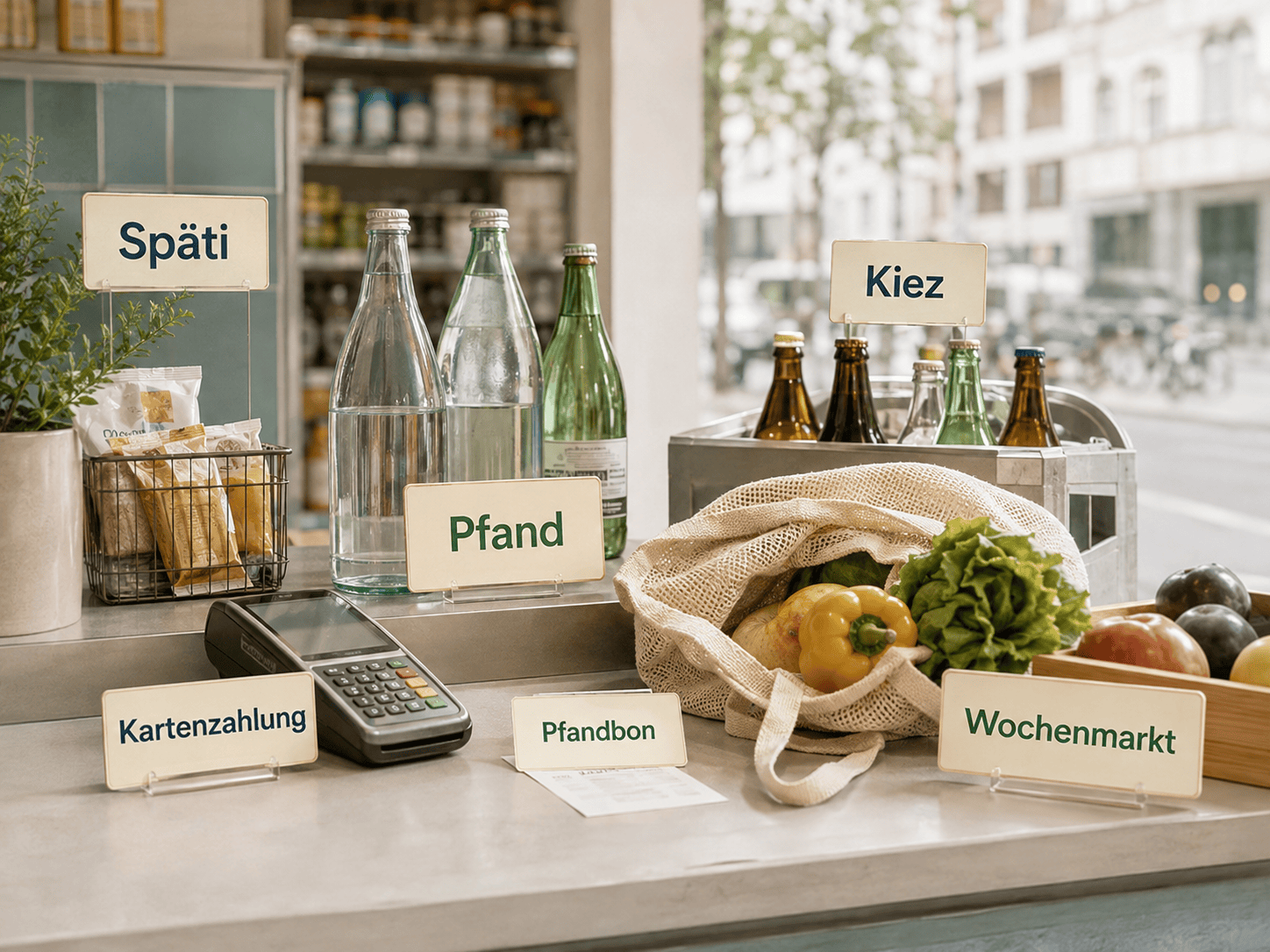
Everyday Berlin is not a list of stereotypes. It is a collection of small routines: returning a bottle, checking whether a shop is open, asking if you can pay by card, recognising a Späti and understanding why someone describes a place as their Kiez.
This guide explains useful words and habits without pretending that every Berliner behaves in the same way. Berlin is diverse, and routines vary by neighbourhood, household and situation.
The short answer
You will settle in faster if you learn a few systems instead of memorising cultural rules:
- check opening hours, especially on Sundays and public holidays;
- ask how you can pay rather than assuming;
- return bottles and cans that carry a deposit;
- separate household waste according to the local containers;
- treat a Kiez as someone’s everyday neighbourhood, not an official boundary;
- use direct, polite language when you need information.
1. Your Kiez is your small everyday Berlin
In Berlin, Kiez usually means the immediate neighbourhood people use in daily life: nearby streets, shops, cafés, parks and familiar places. It is smaller and less official than a Bezirk or Ortsteil.
Someone may say:
Ich wohne gern in meinem Kiez.I like living in my neighbourhood.
The word does not tell you exactly where the boundary is. It describes belonging and everyday geography more than administration.
2. What is a Späti?
Späti is short for Spätkauf. It is a small late shop associated especially with Berlin. A Späti may sell drinks, snacks and basic everyday items and can also function as a local meeting point.
Do not assume that every Späti is legally allowed to open at every time or sell its full range on Sundays. Berlin’s opening rules contain exceptions and conditions, and actual hours vary. Check the shop rather than relying on the name.
Useful phrases:
Haben Sie noch geöffnet?Are you still open?
Kann ich hier mit Karte zahlen?Can I pay by card here?
3. Sunday needs a little planning
Many regular shops are generally closed on Sundays and public holidays, while specific exceptions exist. Some businesses at major stations, certain bakeries, pharmacies on emergency duty, markets or approved Sunday openings may operate under different rules.
The practical habit is simple: buy essentials before Sunday and check official or business-specific opening information when you need something.
Do not build your plan around a generic online list without checking the current date and location.
4. Cash, card or phone?
Cashless payment has grown strongly in Germany, but acceptance is not identical everywhere. Cash also remains widely used. In everyday Berlin, the easiest approach is to look for the payment symbols or ask before ordering.
Kann ich mit Karte zahlen?Can I pay by card?
Nur bar?Cash only?
Kann ich kontaktlos zahlen?Can I pay contactlessly?
The word Kartenzahlung means card payment. Barzahlung means cash payment. A girocard is a common German debit-card system; it is not simply another word for every bank card.
5. Pfand: return, do not throw away
Pfand is a deposit added to certain bottles, cans or reusable containers. When you return an eligible container through the correct return system, the deposit is refunded.
At a supermarket, a return machine is often called a Pfandautomat or Leergutautomat. After returning containers, the machine gives you a Pfandbon. Take the voucher to the checkout.
Not every bottle has the same system. Look for the deposit or reusable marking and follow the retailer’s return information.
Useful phrases:
Wo ist der Pfandautomat?Where is the deposit-return machine?
Kann ich diese Flasche hier zurückgeben?Can I return this bottle here?
6. Waste separation in Berlin
Household waste does not all go into one bin. Berlin uses separate systems for categories such as paper, glass, organic waste, residual waste and recyclable materials.
The official Berlin information notes that the Wertstofftonne for plastics, metals and composite materials may be yellow or orange; both colours accept the same category of materials. Glass is separated through the relevant containers, and hazardous items need special disposal.
When you are unsure, use the official waste guide rather than judging only by the colour of a container.
Common words include:
- Biomüll: organic waste;
- Restmüll: residual waste;
- Altpapier: waste paper;
- Altglas: waste glass;
- Wertstoffe: recyclable materials in the relevant local category;
- Recyclinghof: recycling centre.
7. Wochenmarkt and Flohmarkt
A Wochenmarkt is a recurring weekly market, commonly with food and produce. A Flohmarkt is a flea market with second-hand items, antiques, clothing, books or household goods, depending on the market.
Opening days and locations change, especially for seasonal or temporary markets. Use a current official listing before travelling.
At a market you may hear:
Was kostet das?How much does that cost?
Kann ich mit Karte zahlen?Can I pay by card?
Ich schaue mich nur um.I am just looking around.
8. Feierabend is a time and a feeling
Feierabend means the end of the working day or the time after work. It can be used as a simple statement:
Ich mache jetzt Feierabend.I am finishing work now.
It does not mean that everybody stops at the same time. The useful idea is the transition from work to personal time.
9. Direct language can still be polite
Everyday German requests are often shorter than equivalent English phrasing. Short does not automatically mean unfriendly.
At a counter:
Einmal das hier, bitte.One of these, please.
When you need help:
Entschuldigung, können Sie mir kurz helfen?Excuse me, could you help me for a moment?
When you did not understand:
Können Sie das bitte wiederholen?Could you repeat that, please?
Adding bitte, a greeting and a clear question is enough in many situations.
10. German you will actually need
Frequently asked questions
Are shops in Berlin open on Sundays?
Regular shops are generally closed on Sundays and public holidays, but exceptions and designated Sunday openings exist. Actual opening is not guaranteed, so check the current location-specific information.
What is the difference between a Späti and a supermarket?
A Späti is normally a much smaller late shop with a limited everyday range and a local role. Opening rules and product ranges vary; it is not simply a supermarket that is always open.
Can I pay by card everywhere in Berlin?
No single payment method is guaranteed everywhere. Card and mobile payments are common and growing, while cash remains widely accepted. Check the signs or ask before purchasing.
What do I do with a Pfand bottle?
Return it through a retailer or return point that accepts that type of deposit container. A supermarket machine often issues a Pfandbon that is redeemed at the checkout.
Is a Kiez an official district?
No. Kiez is an informal neighbourhood term. Bezirk and Ortsteil are the official administrative and locality terms.
What is the difference between a Wochenmarkt and a Flohmarkt?
A Wochenmarkt is a recurring market focused especially on food, produce and permitted everyday goods. A Flohmarkt focuses on second-hand and varied used goods.
Useful sentences
Dialogue 1 · Returning bottles
Show English
Dialogue 2 · Paying at a market
Show English
Practice
Check what you remember.
Your answers stay in your browser.
1. What is a Pfandbon?
💡 You receive it after using a deposit-return machine.
2. Complete the question: Kann ich hier mit ___ zahlen?
💡 Think about the payment method you use instead of cash.
3. Which place normally focuses on second-hand goods?
4. Complete the sentence: Ich mache jetzt ___.
💡 Use the word for finishing the working day.
5. What is the safest everyday payment habit?
6. Complete the question: Wo ist der ___?
💡 Use the word for a machine that accepts deposit containers.
Sources checked: 2026-08-14.
Official sources: Berlin.de, “Späti: Meeting Point, Supermarket and Regional Treasure” · Berlin.de, “Shop Opening Hours & Sunday Shopping” · Deutsche Bundesbank, “Payment behaviour in Germany in 2025” · German Environment Agency, “Questions and answers: packaging and packaging waste” · Berlin Senate Department, “Wertstoffe aus Metall, Kunststoff, Verbunden, Glas, Papier, Pappe und Karton” · Berlin.de, “Was kommt in die Biotonne?” · Service Berlin, “Trade – organising trade fairs, exhibitions and markets” · Berlin.de, “Flea Markets in Berlin”