
Last reviewed: September 2026
German Articles: How to Learn der, die and das
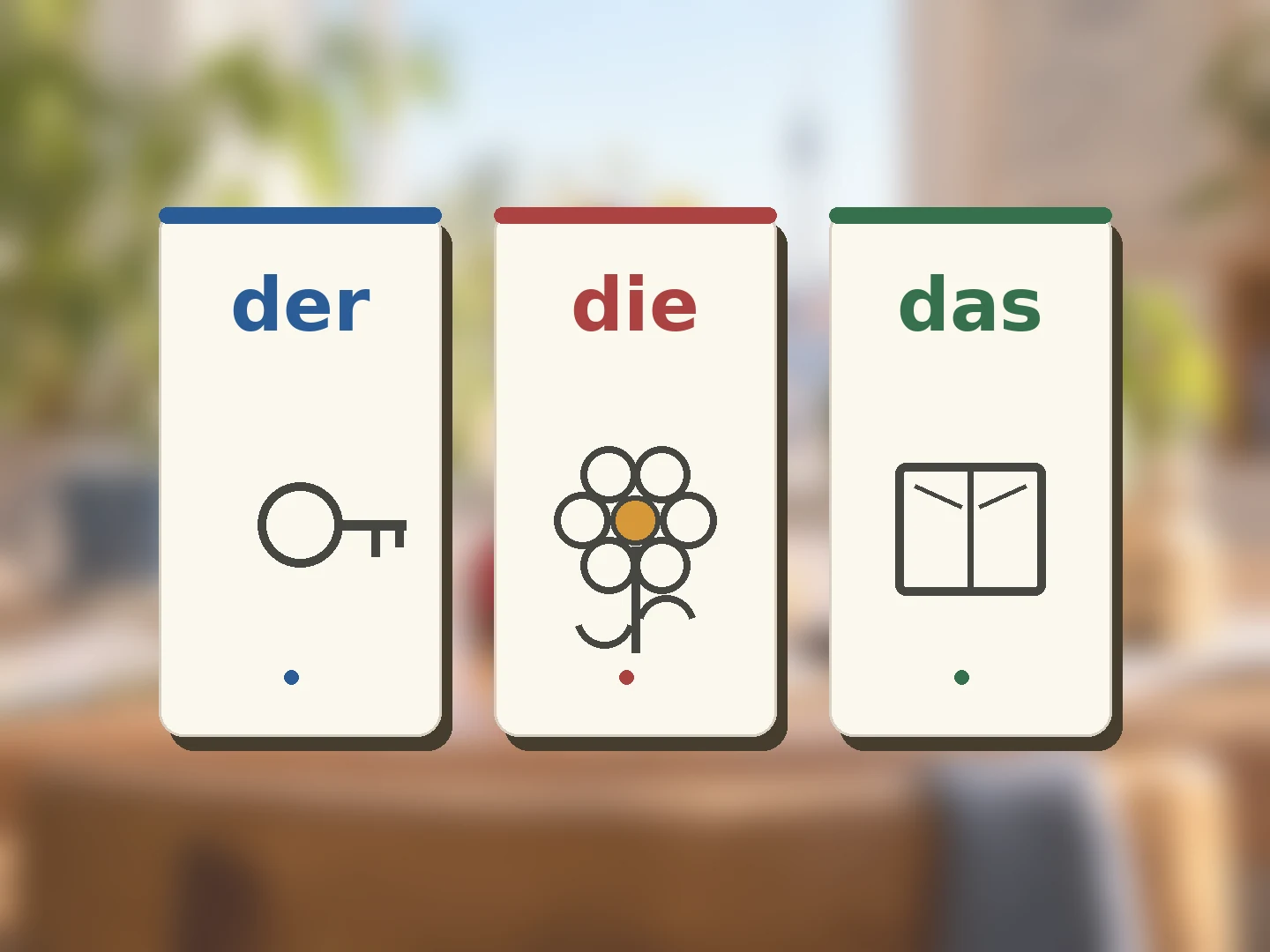
Der, die or das? The most reliable way to learn German nouns is to learn the article with the noun: der Tisch, die Stadt, das Buch. There are useful patterns, but there is no single rule that predicts the correct gender of every German noun.
There is a second challenge too. Articles do more than show grammatical gender: they also change with the case. Der Mann becomes den Mann in the accusative and dem Mann in the dative.
Treat those as two separate jobs – learning a noun’s gender and learning how articles decline – and the system becomes much easier to manage.
What are the German articles?
German has three grammatical genders in the singular:
| Gender | Definite article | Indefinite article | Example |
|---|---|---|---|
| masculine | der | ein | der Tisch, ein Tisch |
| feminine | die | eine | die Lampe, eine Lampe |
| neuter | das | ein | das Buch, ein Buch |
In the nominative plural, the definite article is always die:
die Tische, die Lampen, die Bücher
German has no plural equivalent of the indefinite article a/an. You simply say:
Ich kaufe Bücher. – I’m buying books.
Ich kaufe keine Bücher. – I’m not buying any books.
Why do German nouns have gender?
Grammatical gender belongs to the noun itself. It does not always match natural or biological gender.
For example:
das Mädchen – neuter
die Person – feminine
der Mensch – masculine
That is why trying to find a logical explanation for every article is frustrating. It is much more useful to store the article as part of the vocabulary item.
Learn der Tisch, not just Tisch. Learn die Zeitung, not just Zeitung.
Which endings can help you choose der, die or das?
Some noun endings are strong clues.
Often feminine: die
Many nouns with these endings are feminine:
- -ung: die Wohnung, die Zeitung
- -heit: die Freiheit, die Gesundheit
- -keit: die Möglichkeit, die Schwierigkeit
- -schaft: die Freundschaft, die Mannschaft
- -ei: die Bäckerei, die Polizei
- -ion: die Information, die Situation
- -tät: die Universität, die Qualität
Often neuter: das
Particularly useful patterns include:
- -chen: das Mädchen, das Brötchen
- -lein: das Büchlein
- nominalised infinitives: das Essen, das Lernen, das Schreiben
Many nouns ending in -ment and -um are also neuter, such as das Instrument and das Museum, although these patterns have exceptions.
Often masculine: der
Common clues include:
- -ling: der Frühling, der Schmetterling
- -ismus: der Tourismus, der Realismus
- many nouns referring to male people: der Lehrer, der Student
- days, months and seasons: der Montag, der September, der Winter
Use these as shortcuts, not as a substitute for learning the article with the word.
German articles change with the case
Once you start using nominative, accusative, dative and genitive, the article changes.
Definite articles
| Case | Masculine | Feminine | Neuter | Plural |
|---|---|---|---|---|
| Nominative | der | die | das | die |
| Accusative | den | die | das | die |
| Dative | dem | der | dem | den |
| Genitive | des | der | des | der |
The masculine forms make the pattern especially visible:
Der Mann kommt. – The man is coming.
Ich sehe den Mann. – I see the man.
Ich spreche mit dem Mann. – I’m speaking with the man.
Das Auto des Mannes ist neu. – The man’s car is new.
Some feminine and neuter forms look identical across cases, so it helps to practise articles in sentences rather than memorising a table in isolation.
How to learn German articles more effectively
1. Always learn the article with the noun
Instead of writing:
Tisch = table
write:
der Tisch = table
A short sentence is even better:
Der Tisch steht am Fenster.
2. Use colour as a memory tool, not a rule
Colour-coding masculine, feminine and neuter nouns can help at the beginning. The goal, however, is for der Tisch or die Stadt to feel like one unit, not for you to search your memory for a colour every time you speak.
3. Learn a few reliable endings first
Start with strong patterns such as -ung, -heit, -keit, -chen and -lein. They give you useful shortcuts without forcing you to memorise dozens of weak rules and exceptions.
4. Practise articles inside real sentences
Articles become much more useful when gender and case work together:
Ich kaufe einen Kaffee. – I’m buying a coffee.
Ich sitze mit einer Freundin im Café. – I’m sitting in a café with a friend.
Das Buch liegt auf dem Tisch. – The book is on the table.
5. Keep speaking when you make a mistake
Article mistakes are normal, even at higher levels. If you hesitate in conversation, finish the sentence first. Make a note of the noun and check the article afterwards.
Quick exercise: der, die or das?
Choose the correct article:
1. ___ Universität 2. ___ Brötchen 3. ___ Winter 4. ___ Möglichkeit 5. ___ Museum
Answers: die Universität, das Brötchen, der Winter, die Möglichkeit, das Museum.
The one rule worth remembering
If you remember only one thing from this guide, make it this:
Never learn a German noun on its own. Learn article + noun together.
Patterns help you make good guesses. Repetition, examples and regular speaking are what make the forms automatic.
More from Language & Culture
Contemporary German Music: 10 Artists for German Learners →German Tongue Twisters: 10 Pronunciation Challenges →Free placement test →