
Last reviewed: September 2026
The German Language: All You Need to Know
German is a West Germanic language and the official language of Germany. It is closely related to English and Dutch, but centuries of sound change, regional variation and written standardisation have given modern German a character of its own.
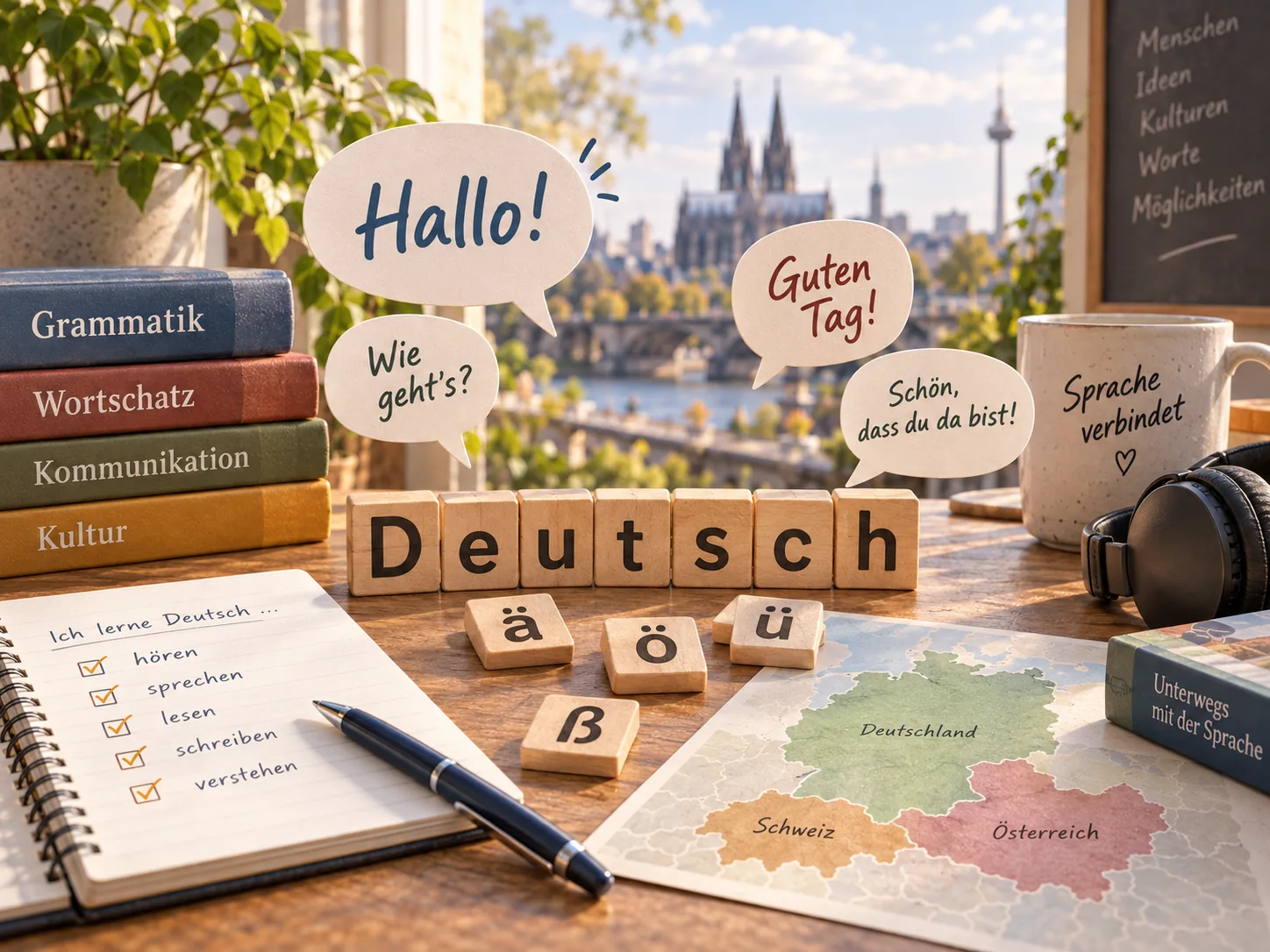
For learners, some features stand out immediately: nouns are capitalised, there are three grammatical genders and four cases, words can be combined into very long compounds, and German verbs sometimes seem to wait until the end of the sentence to reveal the full meaning.
German is also much more varied than a textbook can show. Standard German is only part of the picture; regional accents and dialects are a normal part of everyday life.
Where is German spoken?
German has official or co-official status in several European countries and regions, including Germany, Austria, Liechtenstein, Switzerland, Belgium and Luxembourg. It is also one of the official languages of the European Union.
That does not mean everyone uses exactly the same standard. Austrian German, Swiss Standard German and the standard used in Germany differ in vocabulary, pronunciation and some conventions. Regional dialects add another layer of variety.
A short history of German
German did not suddenly appear in one place, and no single person created the language. It developed over many centuries from West Germanic varieties.
Old High German
Old High German is the name used for a group of southern and central German varieties in the early Middle Ages. There was no single standard language. One of the major developments was the High German consonant shift, which helps explain contrasts that are still visible today, such as Low German maken and Standard German machen.
Middle High German
From roughly the 11th century onwards, Middle High German varieties appear in a growing body of literature and written records. Writing became more widespread, but spelling and usage were still strongly regional.
Early New High German and written standardisation
From the late Middle Ages into the early modern period, different written traditions gradually moved closer together. Martin Luther’s Bible translation had enormous influence because it reached a wide readership, but Luther did not single-handedly invent Standard German. Printing, administration, trade, education and other written traditions also shaped the emerging standard.
A broadly shared spoken standard took much longer to develop.
What makes German distinctive?
Nouns start with capital letters
German capitalises every noun:
- der Tisch – the table
- eine Idee – an idea
- viele Menschen – many people
At first this looks unusual; once you are used to it, it can actually make sentence structure easier to scan.
German has four cases
Nominative, accusative, dative and genitive mark different grammatical roles. Articles make the changes especially visible:
- der Mann
- ich sehe den Mann
- ich helfe dem Mann
- das Auto des Mannes
For a practical example of how case changes meaning, see Wo or Wohin? German Accusative vs Dative.
Three grammatical genders
German nouns are masculine, feminine or neuter: der, die, das. Gender is not always predictable from meaning, so learning a noun together with its article is usually the safest approach.
Compounds are extremely productive
German can combine several words into a single noun. A Sprachkurs is a language course; a Kursbeginn is the start of a course. Longer compounds may look intimidating, but they are often easier to understand once you split them into their parts.
Verbs create a sentence bracket
In a basic main clause, the finite verb normally occupies the second position:
Heute lerne ich Deutsch.
With separable verbs and compound tenses, another verb element can appear at the end:
Ich stehe jeden Morgen früh auf.
Ich habe gestern lange gearbeitet.
This ‘sentence bracket’ becomes much less mysterious once you start noticing it as a recurring pattern.
Umlauts and ß
German uses ä, ö and ü, as well as ß (Eszett). In Swiss Standard German, ss is normally used instead of ß.
How similar are German and English?
Because German and English are related West Germanic languages, they share many cognates: Haus/house, Wasser/water and Name/name, for example.
But related words are not always used in the same way. The classic false friend bekommen means to get or receive, not to become.
Modern German also borrows English words such as Team and Meeting, while adapting others to German grammar, as in downloaden. Borrowing is a normal part of language change, not evidence that German is disappearing.
Standard German and dialects
In everyday conversation, Germans often use Hochdeutsch to mean Standard German. In linguistics, however, High German can also refer to the Central and Upper German dialect groups.
If you want to understand why German sounds so different from Hamburg to Cologne, Frankfurt, Stuttgart or Munich, continue with our guide to German dialects.
Is German really difficult?
German certainly has challenging features: case endings, noun gender, word order and irregular verbs take time. But much of the language is systematic, and many patterns repeat.
The useful question is not whether German is objectively ‘hard’. It is whether you are getting enough meaningful exposure to it. Regular listening, reading and conversation gradually turn rules that once felt abstract into patterns you recognise automatically.
Sources
More from Language & Culture
Why Do Germans Love Döner Kebab So Much? →How to Order Food in German →Free placement test →