
Last reviewed: September 2026
Akkusativ and Dativ: Wo? and Wohin?
Wo? → usually dative. Wohin? → usually accusative. That is a useful rule — as long as you apply it specifically to German two-way prepositions (Wechselpräpositionen).
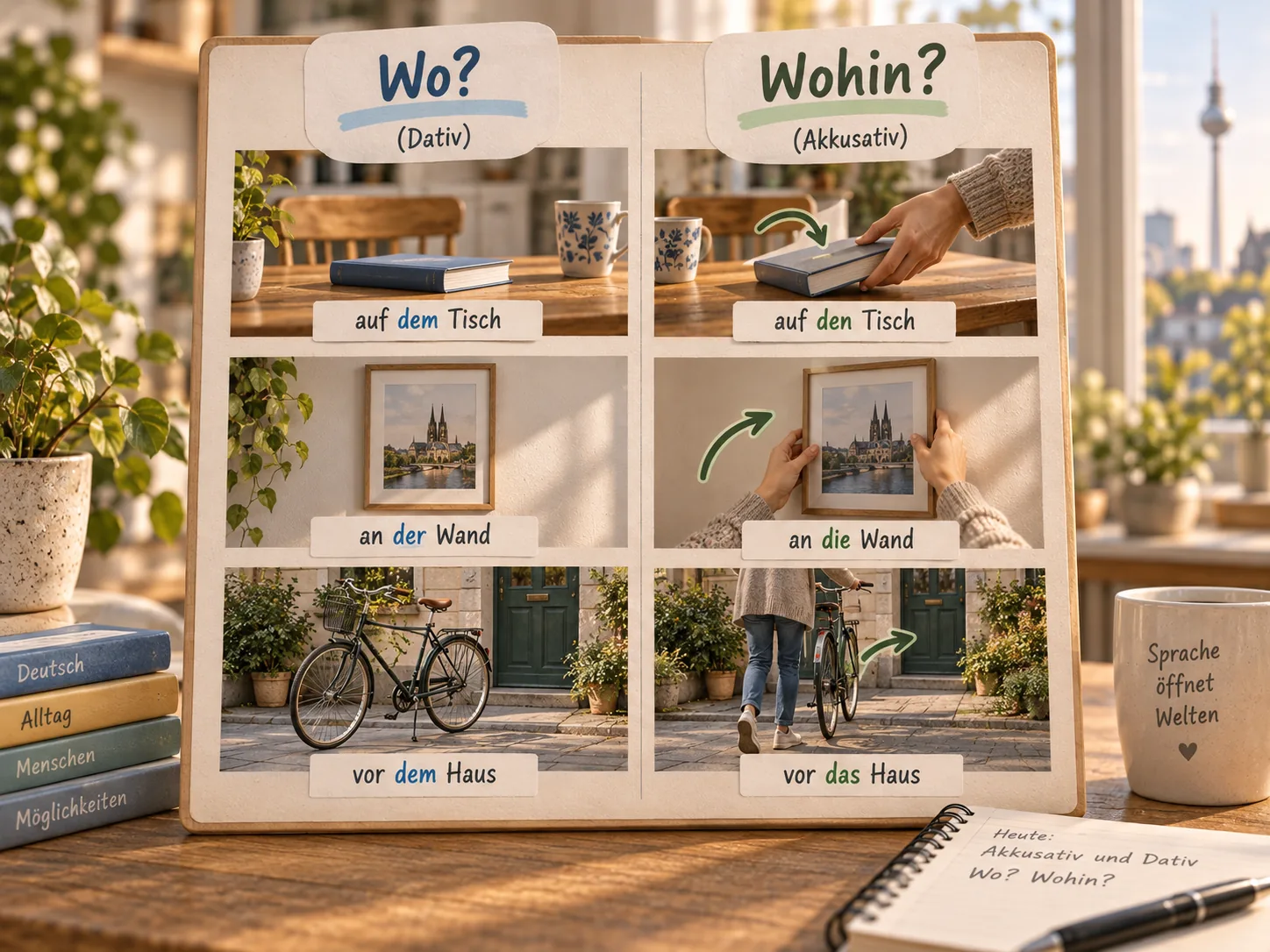
The nine two-way prepositions are:
an, auf, hinter, in, neben, über, unter, vor, zwischen
They can describe either a location or a direction/change of position. That difference determines whether they take the dative or accusative case.
Dativ – Wo?
When the question is Wo? (“where?”), you are describing a location or position. With a two-way preposition, German normally uses the dative.
Wo bist du? – Ich bin in der Schule.
Where are you? – I’m at/in school.
Wo steht das Fahrrad? – Es steht vor dem Haus.
Where is the bike? – It is in front of the house.
Wo liegt das Handy? – Es liegt auf dem Tisch.
Where is the phone? – It is on the table.
Movement itself is not the key. What matters is whether the spatial relationship changes.
Definite articles in the dative
| Nominative | Dative | Example |
|---|---|---|
| der | dem | vor dem Bahnhof |
| das | dem | auf dem Sofa |
| die | der | in der Schule |
| die (plural) | den + n | zwischen den Häusern |
Plural nouns often add -n in the dative if they do not already end in -n or -s.
Akkusativ – Wohin?
When the question is Wohin? (“where to?”), you are describing a destination, direction or change of spatial position. With a two-way preposition, German normally uses the accusative.
Wohin gehst du? – Ich gehe in die Schule.
Where are you going? – I’m going to/into school.
Wohin stellst du das Fahrrad? – Ich stelle es vor das Haus.
Where are you putting the bike? – In front of the house.
Wohin legst du das Handy? – Ich lege es auf den Tisch.
Where are you putting the phone? – Onto the table.
Definite articles in the accusative
| Nominative | Accusative | Example |
|---|---|---|
| der | den | auf den Tisch |
| das | das | vor das Haus |
| die | die | in die Küche |
| die (plural) | die | zwischen die Stühle |
The most visible change is masculine der → den.
Wo or wohin? Three direct comparisons
in + dative / accusative
Wo? Ich bin in der Küche. – I am in the kitchen. Wohin? Ich gehe in die Küche. – I am going into the kitchen.
auf + dative / accusative
Wo? Das Buch liegt auf dem Tisch. – The book is on the table. Wohin? Ich lege das Buch auf den Tisch. – I put the book onto the table.
an + dative / accusative
Wo? Das Bild hängt an der Wand. – The picture is hanging on the wall. Wohin? Ich hänge das Bild an die Wand. – I hang the picture onto the wall.
These pairs are more accurate than the shortcut “movement = accusative”. You can be moving and still use the dative:
Ich gehe auf der Straße.
You are walking, but you remain on the street. The question is Wo gehst du?
Compare:
Ich gehe auf die Straße.
Now you are changing your position and moving onto the street. The question is Wohin gehst du?
Why does “zu” take dative even when you are going somewhere?
Because zu is not a two-way preposition.
Ich gehe zum Bahnhof. – I’m going to the station.
Ich fahre zur Arbeit. – I’m going to work.
Even though both sentences express direction, zu always takes the dative.
So the complete rule is not “Wohin always means accusative”. It is:
With two-way prepositions: Wo? → dative. Wohin? → accusative.
Which preposition should you use: in, an, auf or zu?
Choosing the case is only half the job. German also chooses different prepositions depending on the type of destination or spatial relationship.
- in: into an enclosed space or area → in die Schule, in den Park
- auf: onto a surface and with certain places/events → auf den Tisch, auf den Markt
- an: towards an edge, boundary or vertical surface → an die Wand, ans Fenster
- zu: towards a person, institution or destination without focusing on entering it → zum Arzt, zur Arbeit
You cannot always translate these one-to-one from English. Learning them in complete example sentences is much more reliable.
Mini exercise
Add the correct article:
1. Ich sitze auf ___ Stuhl. (der) 2. Ich setze mich auf ___ Stuhl. (der) 3. Wir sind in ___ Küche. (die) 4. Wir gehen in ___ Küche. (die) 5. Das Auto steht vor ___ Haus. (das) 6. Ich fahre vor ___ Haus. (das)
Answers: 1. dem · 2. den · 3. der · 4. die · 5. dem · 6. das
The rule in 20 seconds
- The two-way prepositions are an, auf, hinter, in, neben, über, unter, vor, zwischen.
- Wo? describes a position → dative.
- Wohin? describes a destination/change of position → accusative.
- Movement alone does not decide the case.
- zu is not a two-way preposition and always takes dative.
More from Language & Culture
5 Great German Series on Netflix →Redewendungen: Common German Idioms, Sayings and Proverbs →Free placement test →