
Last reviewed: September 2026
Living in Germany / Work
Starting a new job in Germany: your first week at work
Your first week at a German workplace is easier when you understand both the routines and the language around you.
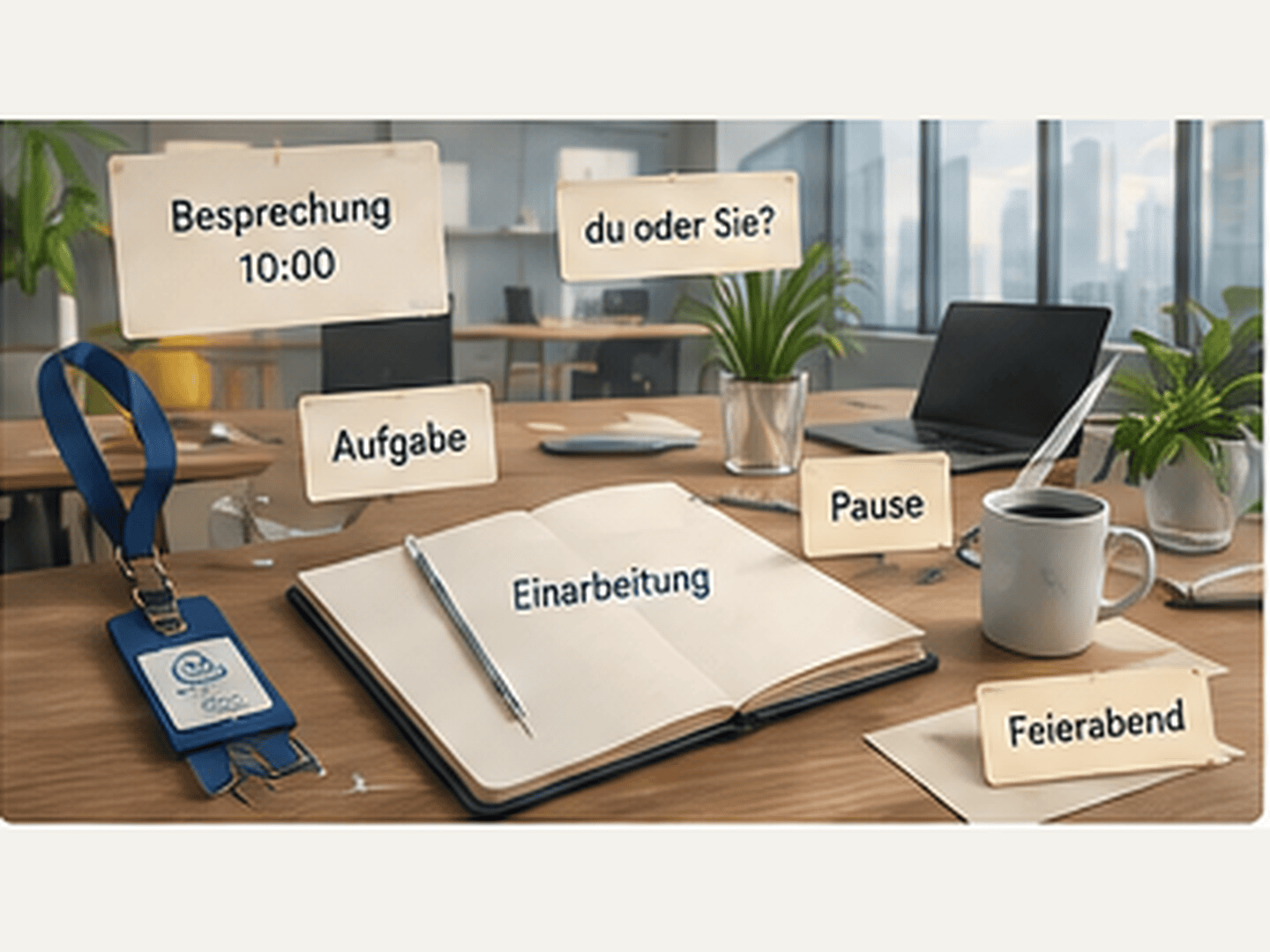
A new workplace comes with names, routines, tools and unwritten habits all at once. If German is not your first language, even small moments, introducing yourself, asking who is responsible or joining a meeting, can take extra energy.
The good news is that you do not need perfect German to handle your first week. A small set of reliable phrases can help you ask questions, understand the plan and connect with colleagues.
Workplaces in Germany are not all the same. A start-up, a hospital, a factory, a university and a family business can have very different cultures. Use this guide as practical language orientation, then follow the rules and routines of your actual employer.
What your first days may include
A structured first day often includes meeting colleagues, seeing your workplace, learning about tools and systems and discussing your first tasks. The German word Einarbeitung is commonly used for the period in which you learn how the job, team and processes work.
You may hear:
Wir beginnen mit der Einarbeitung.
We will start with your onboarding / familiarisation.
or:
Ich zeige dir deinen Arbeitsplatz.
I’ll show you your workstation.
If a colleague gives you a lot of information at once, it is completely useful to slow the conversation down:
Könnten Sie das bitte noch einmal erklären?
Meeting your team
Two very useful questions are:
Wer ist dafür zuständig?
Who is responsible for that?
An wen kann ich mich damit wenden?
Who can I contact about that?
The adjective zuständig appears everywhere in professional German. Learning it early makes many situations easier.
You may also hear the word Aufgabe, meaning task. For example:
Was ist meine erste Aufgabe?
What is my first task?
Du or Sie?
German has two common ways to address another adult: informal du and formal Sie. Workplace practice varies. Some companies use du throughout the organisation; others use Sie in some situations or until someone suggests switching.
If you are unsure, you do not have to guess. Ask:
Soll ich dich duzen oder siezen?
A slightly more formal version is:
Wie möchten Sie angesprochen werden?
Follow the practice of the team you are actually working with rather than assuming one rule applies everywhere.
Meetings and everyday questions
A meeting is a Besprechung. You may also hear Meeting in many workplaces, but Besprechung is a useful word to recognise.
Useful questions include:
Wann beginnt die Besprechung?
When does the meeting start?
Wo findet die Besprechung statt?
Where does the meeting take place?
Soll ich etwas vorbereiten?
Should I prepare anything?
If you miss part of the discussion, try:
Entschuldigung, den letzten Punkt habe ich nicht ganz verstanden.
Sorry, I did not fully understand the last point.
or simply:
Könnten Sie das bitte wiederholen?
Asking for help without sounding helpless
Good workplace communication is not about pretending you understand. It is about making the next step clear.
Instead of only saying Ich verstehe nicht, add what you need:
Könnten Sie mir kurz zeigen, wie das funktioniert?
Could you quickly show me how this works?
Ich bin mit der Aufgabe noch nicht ganz vertraut.
I’m not fully familiar with the task yet.
Habe ich richtig verstanden, dass …?
Have I understood correctly that …?
These phrases show that you are actively trying to understand the process.
Breaks and Feierabend
Pause means break. Feierabend means the end of the working day or the time after work. The exact schedule and break arrangements depend on the workplace, so ask your employer about the routine rather than assuming.
Useful questions:
Wann machen wir Pause?
When do we take a break?
Wann ist heute Feierabend?
When does the working day finish today?
The second sentence is everyday language, so tone and context matter. In a new workplace, a more neutral question may be:
Bis wann arbeiten wir heute?
If you are sick or cannot come in
Every employer has internal communication procedures. Instead of relying on a general article for employment-law rules, ask early how your workplace wants absences to be reported.
Useful vocabulary includes Krankmeldung and the phrase:
Wen soll ich informieren, wenn ich krank bin?
Who should I inform if I am sick?
For legal questions about sick leave, certificates, pay or contractual obligations, use official or qualified advice relevant to your situation.
Mini dialogue: the first morning
New employee: Guten Morgen. Ich bin neu im Team.
Colleague: Willkommen! Ich zeige dir zuerst deinen Arbeitsplatz.
New employee: Danke. Soll ich dich duzen oder siezen?
Colleague: Wir duzen uns hier. Die erste Besprechung ist um zehn Uhr.
New employee: Gut. Soll ich etwas vorbereiten?
Colleague: Noch nicht. Danach zeige ich dir deine erste Aufgabe.
New employee: Perfekt. Und wenn ich später eine Frage habe: Wer ist dafür zuständig?
Colleague: Du kannst zuerst zu mir kommen.
A useful first-week habit
Write down three things each day:
- one new name or role
- one process you learned
- one German phrase you want to use again
This turns the first week into manageable pieces instead of one large language test.
German you actually need
Useful phrases
Practice
Practice
Suggested level: A2–B1
Exercise 1: Match the word
- Besprechung
- Einarbeitung
- Aufgabe
- zuständig
- Pause
- Feierabend
a. task
b. responsible
c. meeting
d. familiarisation / onboarding
e. break
f. end of the workday
Exercise 2: Choose the best phrase
- You did not understand the explanation.
A. Könnten Sie das bitte noch einmal erklären?
B. Ich muss den Termin absagen.
C. Ich habe ein Rezept.
- You want to know who handles a topic.
A. Wer ist dafür zuständig?
B. Ist das vorrätig?
C. Welche Frist gilt?
- You are unsure about du or Sie.
A. Soll ich dich duzen oder siezen?
B. Wann wäre der nächste Termin?
C. Wo ist die Packungsbeilage?
Exercise 3: Fill in the blanks
Use: Besprechung · Einarbeitung · Aufgabe · Pause · zuständig
- Die __________ beginnt um zehn Uhr.
- Was ist meine erste __________?
- Wer begleitet meine __________?
- Wann machen wir __________?
- Wer ist dafür __________?
Exercise 4: Put the dialogue in order
A. Wir duzen uns hier.
B. Guten Morgen. Ich bin neu im Team.
C. Soll ich dich duzen oder siezen?
D. Willkommen! Ich zeige dir deinen Arbeitsplatz.
E. Danke!
Exercise 5: Your turn
Write one polite question you could ask when you need help with a new task and one question about a meeting.
Show answers
Exercise 1
1–c, 2–d, 3–a, 4–b, 5–e, 6–f
Exercise 2
1–A, 2–A, 3–A
Exercise 3
- Besprechung
- Aufgabe
- Einarbeitung
- Pause
- zuständig
Exercise 4
B → D → C → A → E
Exercise 5
Open production task. Example: “Könnten Sie mir kurz zeigen, wie das funktioniert?” / “Wann beginnt die Besprechung?”
Frequently asked questions
What does Einarbeitung mean?
Einarbeitung is the period in which a new employee becomes familiar with tasks, processes, tools and the workplace.
Should I use du or Sie with colleagues in Germany?
There is no single rule for every workplace. Follow the practice of your team and ask if you are unsure.
How can I ask someone to explain something again?
You can say: Könnten Sie das bitte noch einmal erklären? In an informal setting: Könntest du das bitte noch einmal erklären?
What does zuständig mean at work?
Zuständig means responsible for a topic, task or process. Wer ist dafür zuständig? asks who is responsible.
What does Feierabend mean?
Feierabend refers to the end of the working day and, in everyday language, the time after work.
Sources & note
Make it in Germany: Onboarding & welcome days
https://www.make-it-in-germany.com/en/looking-for-foreign-professionals/integration/new-employees/onboarding
Official federal portal: first-day onboarding commonly includes introductions, workplace orientation and discussion of tasks; used only as general orientation.
Make it in Germany: Be prepared
https://www.make-it-in-germany.com/en/looking-for-foreign-professionals/integration/new-employees/preparations
Official federal portal: employers and colleagues can support newly arrived professionals in settling into everyday work.
Related guides
Visiting a doctor in GermanyHealthAnmeldung in GermanyFirst Days & PaperworkFinding an apartment in GermanyHousing